

What Is Male Pattern Hair Loss? Causes, Stages and Treatment
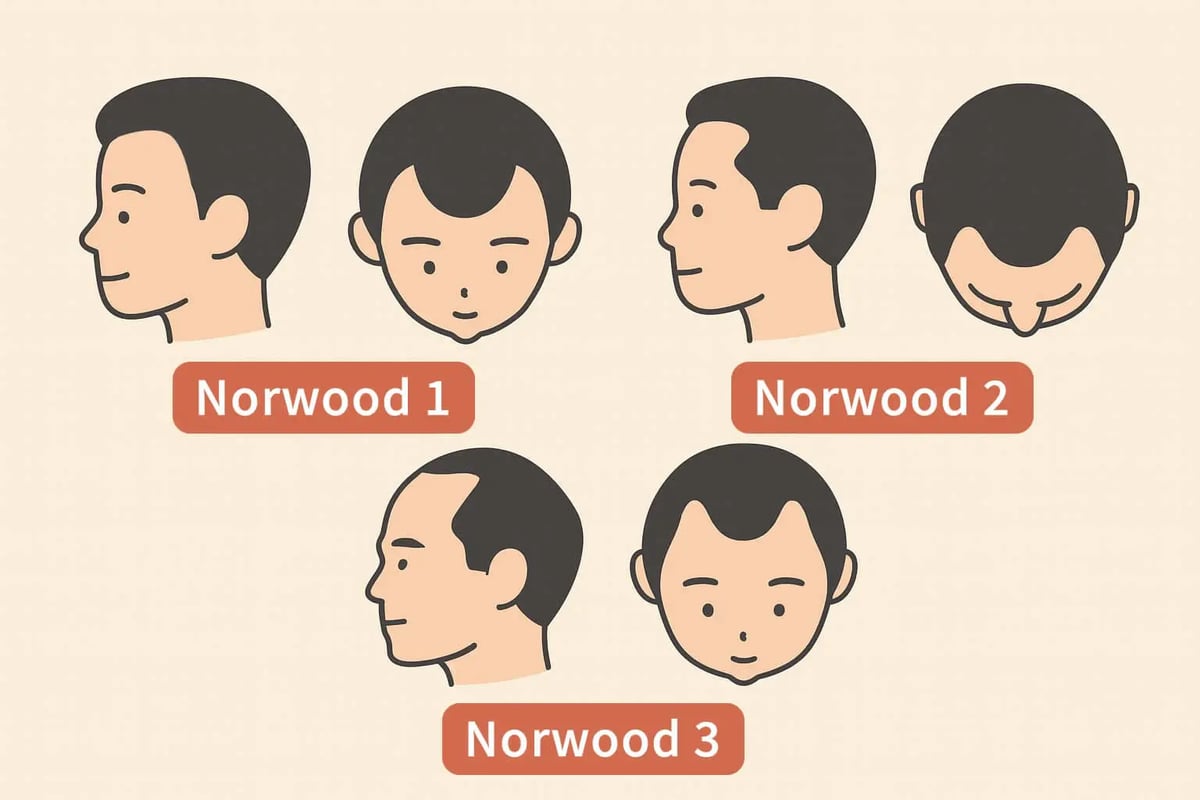
Male androgenetic alopecia, commonly called male pattern hair loss, is a progressive condition that often begins with receding temples, a higher frontal hairline or thinning at the crown. It is related to genetic susceptibility and follicle sensitivity to dihydrotestosterone (DHT), not simply to shampooing, wearing a hat or staying up late.
Key point: Early follicles usually become progressively finer and produce shorter hairs; dramatic shedding may not occur at first. Diagnosis considers the pattern, family history, timing and differences in hair calibre. Medication aims to preserve existing follicles, while a hair transplant redistributes donor follicles—these treatments have different roles.
What is male pattern hair loss, and how does DHT affect follicles?

After puberty, testosterone can be converted to DHT by 5-alpha reductase. In genetically susceptible men, some follicles at the frontal scalp and crown are sensitive to DHT. They gradually miniaturise, their growth phase shortens and each new hair becomes finer.
The tendency is not inherited exclusively from either parent. Multiple genes and hormonal factors are involved. A family history can raise suspicion, but it cannot show that someone will definitely develop hair loss or predict the rate of progression.
What are the early signs, and how do they differ from other hair loss?
Common early changes include recession at the temples creating an M-shaped hairline, a gradually higher frontal hairline and an expanding crown whorl that exposes more scalp under the same lighting. The sides and back are usually relatively preserved.
| What you notice | Possible direction | Sensible next step |
|---|---|---|
| Receding temples, higher hairline or gradual crown thinning | Male pattern hair loss | Compare serial photographs and have hair calibre examined |
| Heavy diffuse shedding over weeks or months | Telogen effluvium or another cause | Review illness, surgery, rapid weight loss, stress and medication |
| Clearly defined round or patchy bald areas | Alopecia areata or another local disorder | Seek a dermatologist’s diagnosis rather than assuming male pattern loss |
| Redness, itch, pain, scale, pustules or crusting | Inflammation or infection | Treat the scalp disorder and exclude scarring hair loss |
If shedding has increased suddenly without a fixed frontal or crown pattern, review the common causes of sudden faster hair loss.
What do the Norwood stages mean?
The Norwood–Hamilton scale describes the visible extent of male pattern hair loss. It is a communication tool, not a prescription. Men at the same stage may have different ages, hair calibre, donor density and future progression.
| Approximate stage | Common appearance | Assessment focus |
|---|---|---|
| Early (about Norwood I–II) | Temples or frontal hairline begin to recede | Distinguish a mature hairline from progressive loss |
| Middle (about Norwood III–V) | M-shaped recession is clearer, sometimes with crown thinning | Consider medication, appearance goals and donor characteristics |
| Later (about Norwood VI–VII) | Frontal and crown areas expand or join | Set realistic coverage and preserve the finite donor supply |
A doctor also assesses the degree of miniaturisation and whether loss is still progressing rapidly. A stage diagram alone cannot determine medication or graft numbers.
How is male pattern hair loss assessed?

Most cases can be evaluated through medical history, distribution and scalp examination. A doctor may ask when the change began, how quickly it progressed, family history, recent illness, rapid weight loss, surgery, stress and medication, then compare hair calibre and density at the front, crown and back.
Trichoscopy can identify variation in shaft diameter, miniaturised hairs and changes in follicular units. Blood tests are not necessary for every man; they may be considered when the pattern is atypical, loss worsens suddenly or symptoms suggest another medical or nutritional issue.
What treatments are available?

Treatment generally aims to slow progression, preserve existing native hair and, where appropriate, improve appearance. The choice depends on age, medical history, extent, expectations and ability to continue treatment.
| Option | Main role | Important limitation |
|---|---|---|
| Topical minoxidil | Supports existing follicles | Needs regular continued use; response and irritation vary |
| Oral finasteride | Reduces DHT effects on susceptible follicles | Prescription medicine requiring contraindication, side-effect and follow-up review |
| Hair transplantation | Redistributes donor follicles into thinning areas | Does not stop non-transplanted native hair from progressing |
| Cosmetic camouflage or observation | Styling, fibres or accepting the current appearance | Does not alter the condition, but remains a valid personal choice |
Minoxidil can irritate the scalp, and a temporary shedding change may occur after starting. Finasteride requires a prescription and an individual discussion of suitability and monitoring; see finasteride safety and side effects for hair loss. Do not buy, increase or stop prescription medication without medical advice.
When should you seek an earlier assessment?
Consider an assessment if the hairline or crown keeps thinning over three to six months, if close relatives developed early male pattern loss, or if the change is affecting daily life. This does not mean medication or surgery must begin immediately.
Sudden heavy shedding, defined bald patches, loss of eyebrows or body hair, or a painful, red, pustular or crusted scalp should not be assumed to be male pattern hair loss. A dermatologist should assess these features.
A note from Dr Wen-Yi Wu
Male pattern hair loss is not diagnosed by counting shed hairs alone. The more useful question is whether a consistent area is becoming thinner and the follicles are miniaturising over time. Assessment considers the hairline, crown, donor region and long-term trend before discussing observation, medication or transplantation.
Medical references
- American Academy of Dermatology: Hair loss diagnosis and treatment
- DermNet: Male pattern hair loss
- Androgenetic Alopecia: A Review (2024)
- A review of the treatment of male pattern hair loss (2020)
- US FDA: PROPECIA (finasteride 1 mg) prescribing information
This article provides general medical education and does not replace individual diagnosis or treatment. Prescription medicines require medical assessment. Seek care promptly for sudden worsening, patchy loss or a painful, inflamed scalp.
Does male pattern hair loss stop by itself? +
Progression may be fast or slow and can appear stable for a time, but male pattern hair loss is generally progressive. Consistent photographs and a medical examination can show whether follicles are continuing to miniaturise.
Is male pattern hair loss inherited only from the mother's side? +
No. It involves multiple genes and hormonal factors, so family history on either side can be relevant. Family history indicates risk but cannot by itself predict age of onset or severity.
Does heavy daily shedding always mean male pattern hair loss? +
No. Patterned thinning at the temples, frontal scalp or crown and progressive hair miniaturisation are more important clues. Sudden diffuse shedding can also follow illness, surgery, rapid weight loss, stress or medication.
Can I use minoxidil without seeing a doctor? +
Long-term self-treatment is not advisable when the diagnosis is uncertain. Minoxidil is not suitable for every cause of hair loss; inflammation, bald patches or rapid worsening should be medically assessed first.
How long does treatment take to show a change? +
Hair cycles are slow, so progress is usually assessed over months and responses vary. Follow the prescribed plan and use photographs taken under consistent conditions rather than changing or stopping medication on your own.
Can I go straight to a hair transplant? +
A doctor should first assess stability, donor density, likely future progression and your goals. Transplantation redistributes follicles but does not stop non-transplanted native hair from continuing to thin.
Related articles
This article has been reviewed and medically approved by Dr. Wen-Yi Wu

Dr. Wen-Yi Wu|Director, Mong Hair Clinic
- ● Fellow of ISHRS (FISHRS)
- ● ABHRS Board-Certified Hair Restoration Surgeon
- ● President of TSHRS (Taiwan Society of Hair Restoration Surgery)