

Can Exosomes Regrow Hair? The Risks and Safety Facts of Exosome Treatments
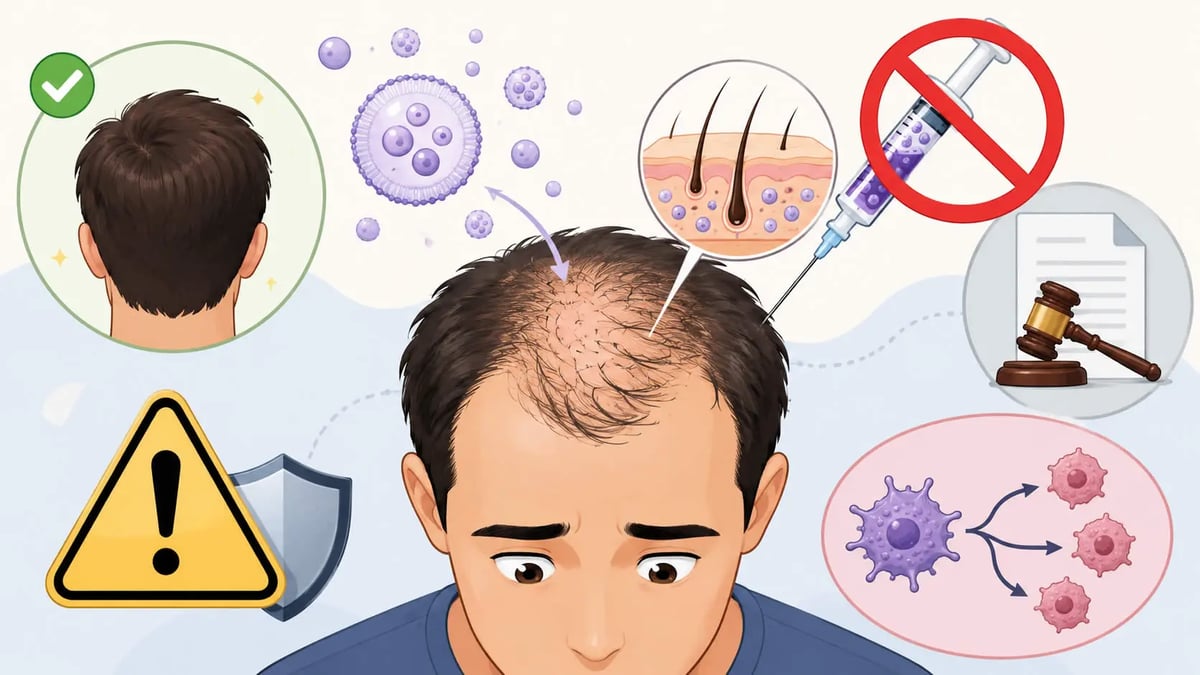
Terms like “exosome hair-growth injections” and “exosomes for male pattern baldness” appear everywhere lately — but can exosomes really grow hair? First, understand what they are and whether there is legal medical approval.
Key point: Exosomes are bioactive cell-signal carriers, not ordinary skincare molecules; cancer research has found that exosomes released by certain cancer cells may help cancer spread. Exosomes are not currently an established, approved hair-loss treatment; in many places they may only be used as a cosmetic ingredient and cannot be injected or claimed to treat anything. To improve hair loss, have a doctor find the cause first, then choose a legal, safe, evidence-based treatment rather than chasing the latest buzzword.
What Are Exosomes, and Can They Grow Hair?
An exosome is a tiny vesicle released by cells that carries biological signals — not a simple nutrient shot or skincare ingredient. Once in the body it can have complex effects and should not be treated as a simple “skincare molecule.”
For hair loss specifically, exosomes are not currently an established, approved therapy. In many places they may only be used as a cosmetic ingredient — not injected, and not claimed to have any effect; in Hong Kong, local health regulations apply. Any treatment that involves injection or efficacy claims should first be confirmed to have legal medical approval. Even if exosomes prove to have medical potential in future, they would still need to pass full human clinical trials, quality control, and regulatory approval before being used as a treatment.
Why Pay Special Attention to Exosome Safety?
Exosomes are bioactive substances, and their effects after injection into the body are hard to predict. Cancer research has found that some highly metastatic breast cancer cells release exosomes carrying special signals that alter the organ micro-environment in advance and raise blood-vessel permeability — effectively “paving the way” for cancer to spread.
This finding does not mean all exosomes cause cancer, but it is a reminder: exosomes are substances with biological signalling function, their effects in the body are complex, and they should not be injected casually as if they were a simple nutrient shot or skincare product.
Can Exosomes Replace a Proper Hair-Loss Diagnosis?
No. There are many causes of hair loss, and the cause must be found first to treat it correctly. Common causes include:
- Male pattern baldness, female-pattern loss, alopecia areata
- Telogen effluvium, postpartum shedding, stress-related loss
- Seborrhoeic dermatitis, scalp inflammation
- Nutritional deficiency, thyroid problems, autoimmune disease
Accepting an expensive exosome course without first confirming the cause may not only fail to improve the loss but also delay genuinely effective treatment. For male pattern baldness, the core problem is follicles affected by androgen-related mechanisms, gradually miniaturising, thinning, and shortening; treatment should assess oral medication, topical solution, a follicle transplant, or a combination based on the degree of loss and follicle state — not be led by a single trendy course.
What to Watch for in “Exosome Hair-Growth” Ads
Exosomes have a cell-signalling function and their effects in the body are not simple, so complete evidence matters all the more. Be especially careful of marketing lines like:
- “Exosome hair-growth injections,” “exosomes for male pattern baldness”
- “Scalp exosome injections to improve loss,” “stem-cell exosomes to activate follicles”
- “Grow hair without taking drugs,” “a stronger hair-growth course than PRP,” “improve volume in one session”
These usually imply efficacy. Whenever injection, treatment claims, or hair-growth effects are involved, confirm whether there is legal medical approval — do not go by clinic ads or a course name alone.
How Does Exosome Injection Compare to Common Hair-Loss Treatments?
Below is a comparison of scalp exosome injection and common hair-loss treatments. Whether any is actually suitable still needs a doctor’s assessment of your situation.
| Treatment | Regulatory and evidence status | Common use direction | Points to note |
|---|---|---|---|
| Scalp exosome injection | Not an established approved hair-loss treatment; injection use largely lacks approval | No legal hair-growth treatment role | Source, ingredients, clinical evidence, and long-term safety are often unclear |
| Oral hair-loss drugs | Prescription drugs, need a doctor’s assessment and prescription | Stable male pattern loss | Have indications and contraindications, need side-effect follow-up |
| Topical hair solution | Some are pharmacist/non-prescription medicines | Early male pattern loss, supportive care | Needs continued use and doctor assessment |
| Follicle transplant | A regular medical surgery | Miniaturised follicles, stable-phase male pattern baldness | Needs donor assessment and long-term planning |
How to Choose Safe Hair-Loss Treatment
The most important thing in treating hair loss is to find the cause first, not to blindly chase the newest course. Early male pattern baldness can usually be stabilised and slowed with medication and non-surgical treatment; only when the hairline recedes, the crown thins, or follicles in the whorl area have clearly miniaturised is a transplant assessed further.
A transplant itself needs full planning too — donor condition, future loss trend, hairline design, density allocation, and long-term maintenance. Genuinely responsible hair-loss care puts safety, legality, and medical evidence first and arranges suitable treatment for each type of loss, rather than steering everyone toward the same course.
Can exosomes regrow hair? +
Exosomes are not currently an established, approved hair-loss treatment; in many places they may only be used as a cosmetic ingredient, not injected or claimed to have effect. To improve hair loss, have a doctor diagnose the cause first, then choose a legal, evidence-based treatment.
Is injecting exosomes for hair loss safe? +
Exosomes are bioactive substances whose effects in the body are hard to predict; research has found exosomes from certain cancer cells may help cancer spread (this does not mean all exosomes cause cancer). So casual injection is not advised, and any injection course should first be confirmed to have legal medical approval and complete information.
Can exosomes replace a hair-loss diagnosis? +
No. Hair loss has many causes (male pattern baldness, telogen effluvium, alopecia areata, scalp inflammation, nutritional or thyroid problems, etc.); an expensive course without first confirming the cause may not help and may delay treatment.
How do I choose safe hair-loss treatment? +
Have a professional doctor assess your loss pattern, scalp condition, family history, medication history, and life stress, arrange blood tests if needed, then choose a legal, safe, trackable treatment based on the cause — don't be led by a new buzzword.
Related articles
This article has been reviewed and medically approved by Dr. Wen-Yi Wu

Dr. Wen-Yi Wu|Director, Mong Hair Clinic
- ● Fellow of ISHRS (FISHRS)
- ● ABHRS Board-Certified Hair Restoration Surgeon
- ● President of TSHRS (Taiwan Society of Hair Restoration Surgery)