

How to Choose a Hair Transplant Method? FUT, FUE and COMBO Compared
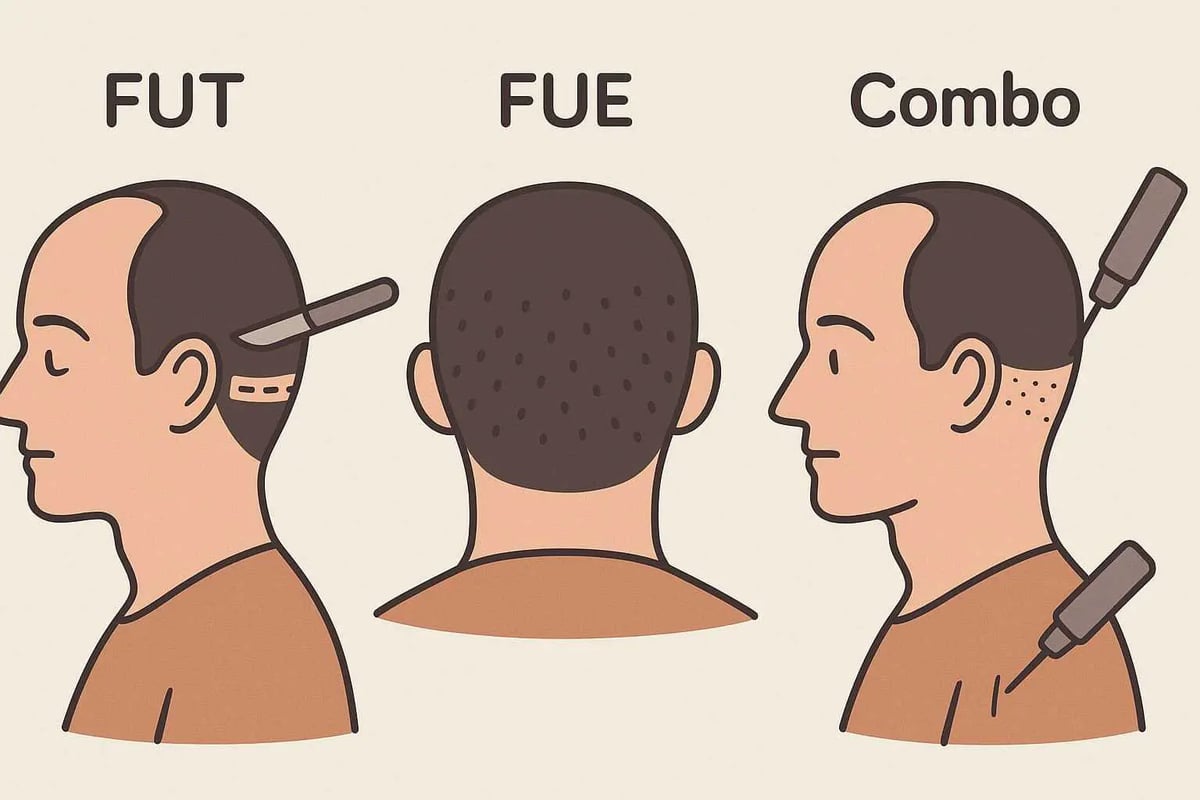
Many people preparing for a transplant ask at their first consultation, “Doctor, should I have FUT or FUE?” In fact there are three main methods — FUT, FUE, and COMBO — and none is simply “the best,” only the one that best suits you.
Key point: FUT suits large areas needing many grafts (mega-sessions); FUE harvests graft by graft with fine scars and faster recovery, suiting small areas or hairline densification; COMBO combines FUT and FUE for very large sessions (over 5,000 grafts). The choice mainly depends on bald area, scar tolerance, and recovery needs — and still needs a professional doctor’s assessment.
The Three Methods at a Glance: FUT, FUE, COMBO
The table below quickly compares FUT, FUE, and COMBO on who they suit, key features, scarring, grafts per session, and recovery.
| Method | Who it suits | Key feature | Scarring | Grafts per session | Recovery |
|---|---|---|---|---|---|
| FUT | Large bald areas | Removes a strip, then separates follicles | One fine linear scar | Many (thousands) | Longer |
| FUE | Small-area adjustment | Extracts graft by graft with a motorised punch | Small dot scars | Medium (1,000–3,000) | Faster |
| COMBO | Very large bald areas | Combines FUT + FUE | Linear + dot scars | Over 5,000 | Medium |
FUT: A Good Choice for Large-Area Restoration
FUT removes a fine strip of scalp from the back and separates the follicles for transplanting, suiting people who need large-area “mega-sessions.” The donor area does not need to be fully shaved, so the effect on appearance is smaller.
- Pros: One surgery can obtain many follicles efficiently; especially suits severe male pattern baldness.
- Cons: The donor area leaves a linear scar; recovery is a little longer than FUE.
FUE: The Natural-Looking First Pick for Small Areas
FUE extracts follicles “graft by graft” with a motorised punch, suiting small-area hairline repair or local densification, with small dot scars that are barely noticeable.
- Pros: No stitching and faster recovery; a natural look with a back-of-scalp scar that is hard to spot.
- Cons: A limited number of grafts per session; large bald areas may need several surgeries.
COMBO: The Golden FUT + FUE Combination
COMBO first uses FUT to obtain many follicles, then tops up with FUE, suiting patients who need “very large sessions” (over 5,000 grafts), balancing efficiency and naturalness.
- Pros: Completes a very large transplant in one surgery; higher overall coverage and more flexible hairstyle design.
- Cons: A longer surgery; very high demands on the doctor’s skill and experience.
How to Pick the Right Method for You
You can consider the choice from three angles:
- Bald area: Small area → FUE; large area → FUT; very large area → COMBO.
- Lifestyle: Don’t want it noticed → FUE; want a big improvement at once → FUT or COMBO.
- Recovery tolerance: Can accept a longer recovery → FUT; want fast recovery → FUE.
The most important thing is not “which method is best,” but “which best suits your loss and lifestyle.” Have a professional doctor assess you first to make the right choice.
Which gives the best result — FUT, FUE, or COMBO? +
None is necessarily best. All three can look natural; the key is not the technique name but the doctor's design, follicle preservation, and your loss condition — suitability is judged by a doctor.
Does FUT always leave an obvious scar? +
FUT leaves a linear scar in the donor area, but it can usually be covered by surrounding hair, with width affected by healing and scalp tension. FUE leaves small dot scars. It varies by individual.
Which should large bald areas choose? +
Large areas usually consider FUT (many grafts per session); if a very large amount is needed (over 5,000 grafts), COMBO may be assessed. Small areas or local densification more often use FUE.
How do I know which method suits me? +
It depends on bald area, donor condition, scar tolerance, and recovery needs. Have a professional doctor check the follicles and donor area first, then plan the best method together.
Related articles
This article has been reviewed and medically approved by Dr. Wen-Yi Wu

Dr. Wen-Yi Wu|Director, Mong Hair Clinic
- ● Fellow of ISHRS (FISHRS)
- ● ABHRS Board-Certified Hair Restoration Surgeon
- ● President of TSHRS (Taiwan Society of Hair Restoration Surgery)