

How to Improve M-Pattern Baldness: Early Signs, Treatment, and Transplant Assessment
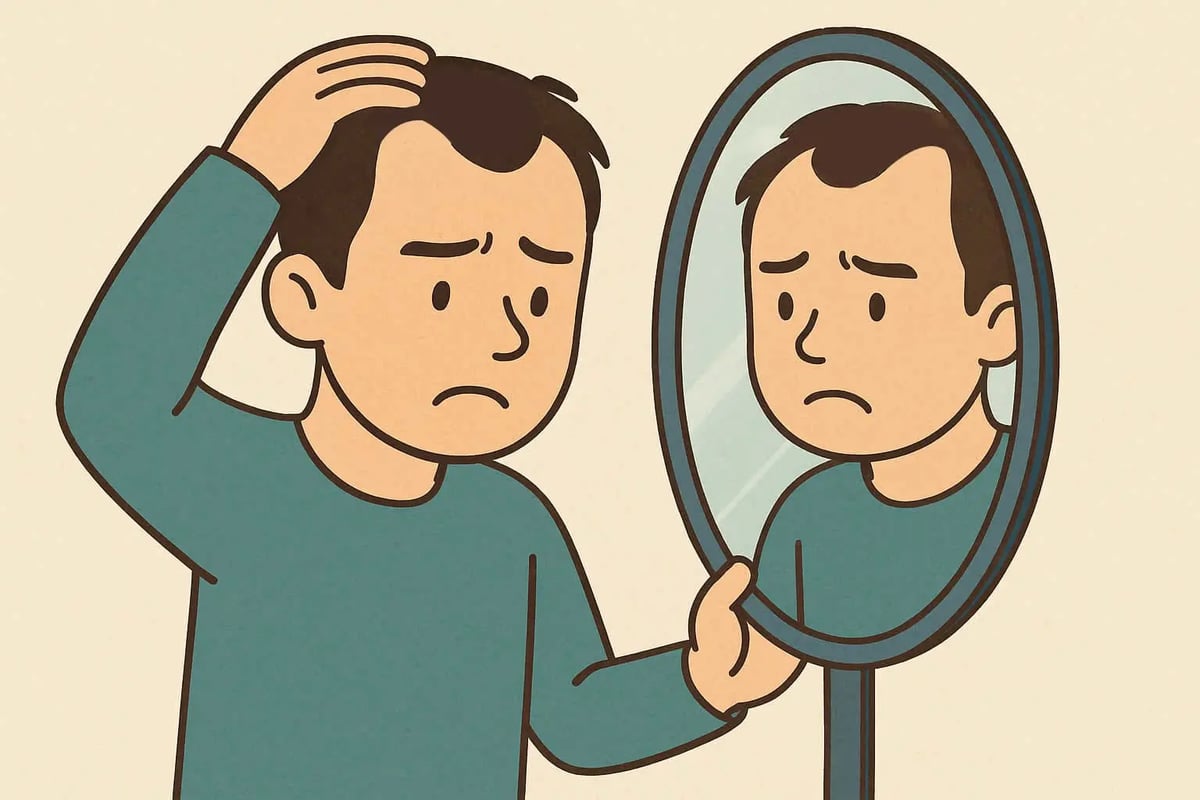
M-pattern baldness is the most common look of male pattern hair loss. It usually starts receding at both temples while the middle of the forehead keeps some hairline, so from the front it resembles an “M.” But a receding temple does not mean you need a transplant right away — the key is first to judge whether it keeps receding and whether the follicles are miniaturising.
Key point: M-pattern baldness starts with receding temples and is linked to genetics and DHT’s effect on follicles. Early on, track it with fixed-angle photos; telling M-pattern baldness apart from a high forehead or a mature hairline matters. Treatment splits into “preserving native hair” (medication) and “rebuilding the hairline” (transplant) — what to do must be assessed by a doctor.
What Is M-Pattern Baldness, and Why Does It Start at the Temples?
M-pattern baldness usually appears first at the left and right temples, with hairline still in the middle of the forehead, so from the front it approaches an “M”; some people later also see reduced density at the forehead or crown, but the speed varies with genetics, age, and follicle sensitivity.
Follicles with a genetic tendency may be more sensitive to dihydrotestosterone (DHT), which shortens the growth phase so once-thick terminal hairs gradually become fine, soft, short hairs — “miniaturisation.” DHT is not the only basis for judgement, though; a doctor still combines hairline shape, differences in hair calibre, family history, and how long it has progressed. Also, M-pattern baldness is not necessarily inherited from the mother’s side — male pattern baldness is shaped by multiple genes and hormonal response together; both the father’s and the mother’s family history can offer clues, and no clear family history does not mean it will not happen.
How to Judge Early M-Pattern Baldness: Watch These 5 Signs
A single selfie is easily affected by lighting, camera distance, and hairstyle. A more reliable way is to fix the shooting conditions and compare over time — take a monthly photo of the front, both temples, and the crown, and keep at least 3–6 months of records. Watch for these five signs:
- Deepening temple outline: The notch above each temple gradually extends backward.
- Uneven hair calibre: More fine, soft, short hairs that are hard to grow long appear at the hairline edge.
- Steadily dropping density: Under the same lighting, more scalp shows at the temples or forehead.
- Styling gets harder: The fringe loses support, and the part or wind exposes the temples more easily.
- Thinning in other areas too: The central forehead or crown also starts to change in density.
If within a few weeks you suddenly shed heavily, get round bald patches, a red, swollen, painful scalp, obvious flaking, or lose eyebrow or beard hair too, it may not be simple male pattern baldness. See a doctor early so they can rule out alopecia areata, telogen effluvium, infection, or inflammatory hair loss.

Telling M-Pattern Baldness, a High Forehead, and a Mature Hairline Apart
A high-looking forehead does not equal balding. The key is whether the hairline has been stable for years, whether the temple hair is miniaturising, and whether the loss is focused in one spot or spread out overall.
| Situation | Common signs | How it changes | Suggested next step |
|---|---|---|---|
| M-pattern baldness | Receding temples, finer edge hairs | Usually progresses gradually, may also thin the forehead or crown | Track with photos, doctor checks follicles |
| Naturally high forehead | Higher forehead proportion, but hairline and density similar for years | Mostly stable | If only the proportion bothers you, consult on hairline design |
| Mature hairline | Hairline moves up slightly after puberty, temples recede a little | Usually limited movement | Keep observing; see a doctor if hair thins |
| Telogen effluvium | Overall shedding rises, not always at the temples | Often after stress, illness, surgery, or rapid weight loss | Assess triggers, nutrition, and related illness |
| Traction hair loss | Thinning where hair is tied or pulled, possible breakage | Related to long-term styling habits | Stop pulling and assess follicle damage |
| Alopecia areata or inflammatory loss | Sharply bordered bald spots, redness, itch, flaking, or pain | May be faster or recurring | Do not self-medicate; see a doctor early |
How to Improve M-Pattern Baldness? Choosing Treatment Options
Improvement splits into “preserving native hair” and “rebuilding the hairline.” When there are still many miniaturised hairs and loss keeps progressing, medication and follow-up usually come first; a transplant is assessed further only when the temples no longer have improvable follicles, the aesthetic need is clear, and the donor area is suitable.
- Topical minoxidil: Can be used for some male-pattern cases; usually needs regular use for a while before judging the response. It may cause scalp irritation, dryness/itch, or early shedding change, and the effect may fade after stopping — follow the product insert and the doctor’s instructions.
- Oral finasteride: A prescription drug, may be used for some male cases to lower DHT’s effect on sensitive follicles; suitability must weigh sexual-function issues, mood change, breast discomfort, plans to conceive, and other history. Pregnant or possibly pregnant people should not handle broken tablets; starting and stopping should be assessed by a doctor.
- PRP, laser caps, or supplements: Their evidence strength, cost, and suitable users differ, so they cannot all be seen as substitutes for medication or a transplant. Address the cause if there is iron, thyroid, or nutritional deficiency; without evidence of deficiency, extra supplements do not necessarily improve M-pattern baldness.
| Option | Main purpose | More often considered when | Limits and follow-up |
|---|---|---|---|
| Observation and photo tracking | Confirm whether it keeps progressing | Change is unclear or undiagnosed | Needs fixed angle, lighting, and regular comparison |
| Topical medication | Maintain or improve some native hair | Still has miniaturised hairs | Needs regular use, watch for scalp discomfort |
| Oral prescription drug | Slow some male-pattern progression | Male cases with a doctor-confirmed indication | Has contraindications and side effects, needs ongoing follow-up |
| Treating scalp disease | Reduce inflammation and extra loss factors | With redness/itch, flaking, or pain | Confirm the diagnosis first, do not self-mix drugs |
| Transplant | Redistribute donor follicles, rebuild the temples | Loss plan is stable and donor area is suitable | Has surgical risk, native hair still needs managing |
| Hairstyle or concealer | Short-term visual improvement | Not yet accepting medication or surgery | Does not change the follicle state |
Is M-Pattern Baldness Suited to a Transplant? What to Assess Pre-Op
A transplant redistributes follicles from a donor area such as the back of the scalp to the temples; it does not increase the total number of follicles. Suitability is not just about the size of the “M” notch — it also considers donor density, hair calibre, scalp condition, loss speed, age, and the range that may expand in future. Pre-op, a doctor generally checks:
- Loss diagnosis: Confirm it is male pattern baldness, not active alopecia areata or inflammatory loss.
- Donor condition: Assess back-of-scalp follicle density, calibre, and the range that can be safely harvested.
- Hairline design: Match face shape, age, and future loss, avoiding designing it too low and using up resources.
- Preserving native hair: A transplant does not stop untransplanted areas from thinning; long-term follow-up must be discussed.
- Surgical risk: May include swelling, bleeding, infection, numbness, folliculitis, temporary telogen shedding, or density below expectation.
If you are young and the loss is still progressing fast, an immediate transplant is not necessarily suitable — designing the hairline too low too early can later create a density gap between transplanted and native hair and use up donor resources sooner; such cases usually need stable loss and a more conservative long-term design assessed first. After a transplant, native hair can still be affected by male pattern baldness; whether to add medication, scalp care, or regular follow-up is decided by a doctor based on your situation.
What to Prepare Before an M-Pattern Baldness Appointment
Full records help the doctor tell long-term progression from short-term shedding and make it easier to discuss treatment priorities. If you have used a hair-growth product, don’t just say “I applied something” — note the name, form, frequency, duration, and any adverse reaction. Bring:
- Front, side, and crown photos from the past 1–3 years.
- Fixed-angle hairline records from the last 3–6 months.
- Your father’s and mother’s family loss pattern and age of onset.
- Current medication, supplements, chronic illness, and allergies.
- Recent stress, late nights, rapid weight loss, fever, surgery, or major illness.
- Plans to conceive, plus the treatment time, risk, and budget you can accept.
The visit usually looks at loss distribution, calibre differences, and scalp condition, with further tests arranged if needed. Online photos can give direction but cannot replace palpation, follicle examination, and a full history.
What does early M-pattern baldness usually look like? +
Commonly, both temples gradually recede, the hair at the hairline edge gets finer and shorter, and the fringe loses support. Track with fixed-angle photos for 3–6 months, and if it keeps changing, have a doctor check the follicles.
Can M-pattern baldness be improved with medication alone? +
It depends on whether the follicles are still there and on the cause. When miniaturised hairs remain, some cases can maintain or improve with medication after a doctor's assessment; temples that have lost follicles are usually hard to rebuild with drugs alone and may need a transplant assessment.
Does M-pattern baldness always need a transplant? +
Not necessarily. Treatment depends on whether it keeps progressing, the follicle state, history, and personal preference; options include topical treatment, follow-up, treating scalp disease, or a transplant. Oral drugs have indications, contraindications, and side effects and cannot be self-applied.
Do I still need to treat native hair after a transplant? +
A transplant does not stop the surrounding native hair from being affected by male pattern baldness. The transplanted area and native hair are assessed separately; whether to add medication, scalp care, or follow-up should be planned by a doctor for your situation.
Related articles
This article has been reviewed and medically approved by Dr. Wen-Yi Wu

Dr. Wen-Yi Wu|Director, Mong Hair Clinic
- ● Fellow of ISHRS (FISHRS)
- ● ABHRS Board-Certified Hair Restoration Surgeon
- ● President of TSHRS (Taiwan Society of Hair Restoration Surgery)