

The Effectiveness of PRP for Male Pattern Baldness and Genetic Hair Loss
What is PRP? Can PRP Improve Hair Loss?
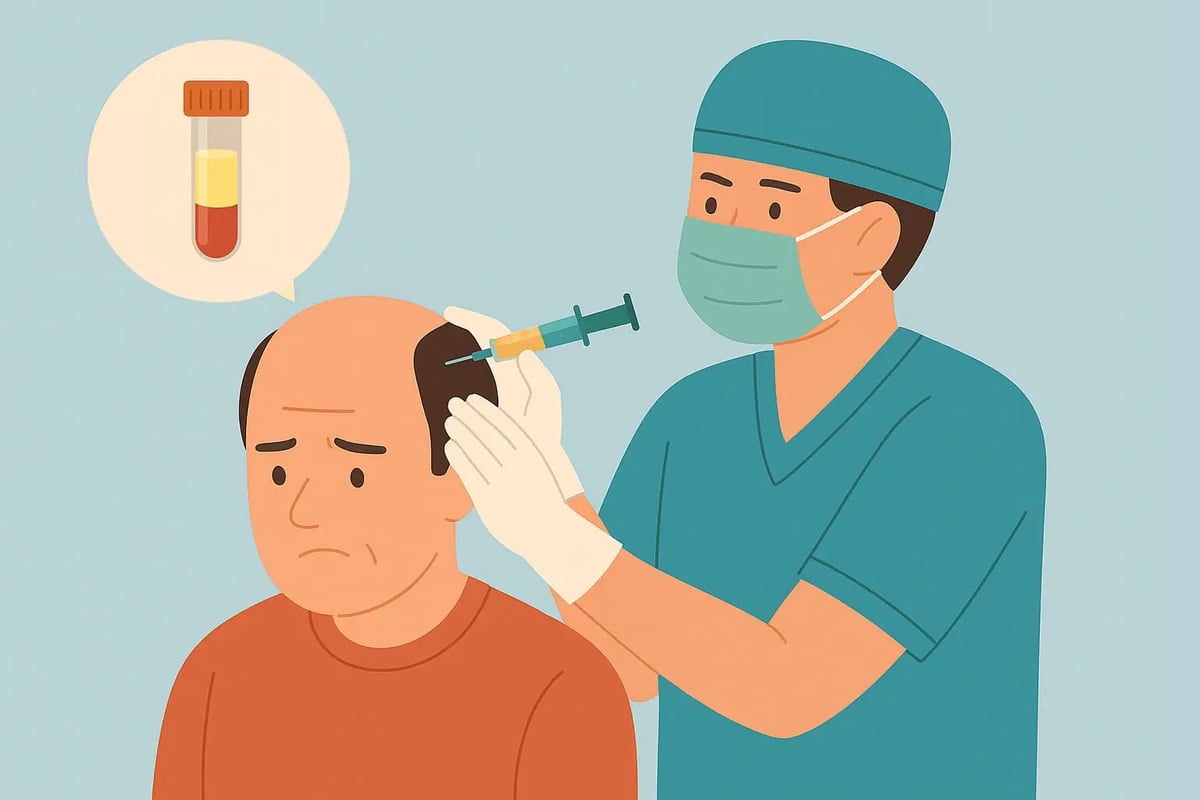
PRP is the abbreviation for Platelet-Rich Plasma, often referred to in Chinese as Platelet Concentrated Plasma.
The typical PRP treatment procedure includes:
| Step | Description |
|---|---|
| Blood Draw | Collect blood from the patient |
| Centrifugation | Use centrifugation technology to separate a high concentration of platelets |
| Scalp Injection | Inject the platelet concentrate back into the scalp |
Platelets contain various growth factors (Growth Factors) which theoretically can stimulate the activity of hair follicle cells and promote tissue repair and regeneration.
However, in actual clinical applications, the efficacy of PRP for male pattern baldness and hereditary hair loss remains a subject of much controversy. It is not suitable for all patients with hair loss and should not be regarded as a primary treatment method.
Limited Effectiveness of PRP as a Standalone Treatment for Male Pattern Baldness
Current research indicates that when Platelet-Rich Plasma (PRP) is used as a single treatment method, its effectiveness for male pattern baldness is generally limited.
Some smaller studies suggest that PRP may provide the following benefits:
- Improve hair texture
- Slight increase in hair density
- Slight improvement in hair volume for some patients
- Improve the condition of scalp healing
Overall, however, hair loss treatment with PRP still faces the following limitations:
| Limitation | Explanation |
|---|---|
| Unstable results | There is significant variation in response between different patients |
| Lack of long-term follow-up | Long-term maintenance of results remains unclear |
| Limited benefit for moderate-to-severe male pattern baldness | Results are usually unsatisfactory for patients with obviously atrophied hair follicles |
| Not suitable as primary therapy | Most patients still require medication or other treatments in conjunction |
Therefore, in clinical practice, PRP is typically not regarded as the primary treatment method for male pattern baldness or hereditary hair loss.
PRP Treatment for Hair Loss Not Yet FDA Approved
Another important fact patients need to know:
Currently, the U.S. Food and Drug Administration (FDA) has not approved PRP for the treatment of hair loss.
PRP does indeed have other medical applications, for example:
- Joint treatment
- Sports trauma repair
- Wound healing
- Tissue repair
However, in the aspect of hair regenerative therapy, PRP remains an off-label use (non-approved indication).
This represents:
- Clinical evidence is still not considered sufficient
- Treatment efficacy has not yet been fully verified
- Different clinics may employ greatly varying techniques
- Long-term safety and maintenance data remain limited
Therefore, before undergoing PRP hair loss treatment, patients should have a detailed assessment by a physician and fully understand the limitations of the procedure, instead of making the decision to receive treatment solely based on advertising.
PRP Requires Repeated Treatments; Costs and Burden Are High
PRP hair loss treatment is not a course of treatment that is completed in one go; it mostly requires long-term, repeated injections.
| Item | Description |
|---|---|
| Initial Course | Typically 1 injection per month, for 3 to 6 consecutive months |
| Maintenance Course | May require an additional injection every 3 to 6 months |
| Common Discomfort | Scalp swelling, bruising, pain |
| Potential Risks | Infection, inflammation, discomfort at injection site |
| Financial Burden | Requires multiple treatments; long-term costs are higher |
For many patients, PRP is not just a matter of medical effectiveness but also involves the burden of time, money, and repeated treatments.
If patients expect PRP to resolve androgenetic alopecia (male pattern baldness) or hereditary hair loss in one go, this usually does not match reality.
Patients Already Using Finasteride Usually Do Not Need PRP Unless Necessary
For male androgenetic alopecia patients, current medical treatment options with sufficient evidence include:
- Finasteride
- Minoxidil
Of these, Finasteride belongs to a 5α-reductase inhibitor; it can lower DHT (dihydrotestosterone) levels, slowing follicular atrophy, and is one of the common core medications for treating male androgenetic alopecia.
Clinically, Finasteride usually needs to be used continuously for a period before effects can be observed:
| Treatment Duration | Possible Changes |
|---|---|
| 3 to 6 months | Hair loss situation gradually stabilizes |
| 6 to 12 months | Some patients see improvement in hair volume |
| Long-term use | Helps delay the worsening of androgenetic alopecia |
If a patient is using Finasteride steadily and is experiencing good treatment results, adding PRP to this is usually unlikely to bring a significant additional improvement.
In other words, one does not necessarily need to increase unnecessary medical expenses just to “add another treatment modality”.
The True Position of PRP in Hair Loss Treatment
PRP is not completely valueless, but its role should be an adjuvant therapy, not the core treatment for androgenetic alopecia or hereditary hair loss.
| PRP Therapy Position | Doctor’s Recommendation |
|---|---|
| Adjuvant Therapy | Patients unsuitable for medication or those wishing to improve hair quality can consider this after evaluation |
| Not the primary treatment | Most patients with androgenetic alopecia still rely on medication, which has more stable evidence |
| Not yet FDA-cleared for hair loss treatment | Patients should understand its limitations before undergoing treatment |
| Variable effects | Overly high expectations regarding regrowth results should be avoided |
For patients with androgenetic alopecia and hereditary hair loss, the most important factor is to first clarify the cause of hair loss, evaluate the follicular condition, and then decide on an appropriate treatment strategy.
Q1: Is PRP treatment for hair loss really effective? +
PRP may offer mild help to certain patients, such as improving hair quality, scalp condition, or hair density, but the overall effectiveness is unstable and lacks sufficient long-term research evidence. Therefore, PRP is not typically regarded as a primary treatment for hair loss.
Q2: Can PRP treat androgenetic alopecia (male/female pattern baldness)? +
The effectiveness of PRP for androgenetic alopecia is limited, especially for patients with moderate or severe cases; relying solely on PRP is usually difficult to achieve significant improvement. Clinically, most treatments still primarily use Finasteride, Minoxidil, and other treatments supported by substantial evidence.
Q3: How many sessions of PRP treatment for hair loss are needed? +
A general PRP hair loss course may include an initial phase of once a month for 3 to 6 sessions; thereafter, maintenance treatment is performed every 3 to 6 months depending on the situation. Therefore, PRP belongs to a course requiring long-term and repeated treatments.
Q4: Are there side effects to PRP hair loss treatment? +
PRP uses the patient's own blood and is relatively safe, but swelling (edema) of the scalp, bruising, pain, discomfort at the injection site, and even infection risks may still occur. Therefore, it must still be evaluated and administered by a qualified medical professional.
Q5: Since I am already taking Finasteride, do I still need to do PRP? +
If the Finasteride treatment is stable, PRP is generally not necessary in most cases, as it usually cannot provide a significant additional improvement. Whether an additional regimen is needed should be evaluated by the doctor based on the degree of hair loss, follicular status, and treatment goals.
Q6: Is PRP suitable for everyone suffering from hair loss? +
No. PRP is not suitable for all hair loss patients. If the cause of hair loss is hormonal, genetic, nutritional deficiency, thyroid problems, or cicatricial alopecia, the true cause must first be identified before deciding on a treatment direction.
Q7: Can PRP replace hair transplantation? +
No. PRP is mainly an adjunctive therapy and cannot recreate hair follicles that have disappeared or are severely atrophied. If hair follicle density is clearly insufficient, it may be necessary for the doctor to evaluate whether hair transplant surgery is suitable.
Related articles
This article has been reviewed and medically approved by Dr. Wen-Yi Wu

Dr. Wen-Yi Wu|Director, Mong Hair Clinic
- ● Fellow of ISHRS (FISHRS)
- ● ABHRS Board-Certified Hair Restoration Surgeon
- ● President of TSHRS (Taiwan Society of Hair Restoration Surgery)