

Hair Loss in Young Adults: Causes, How to Improve It, and Transplant Assessment
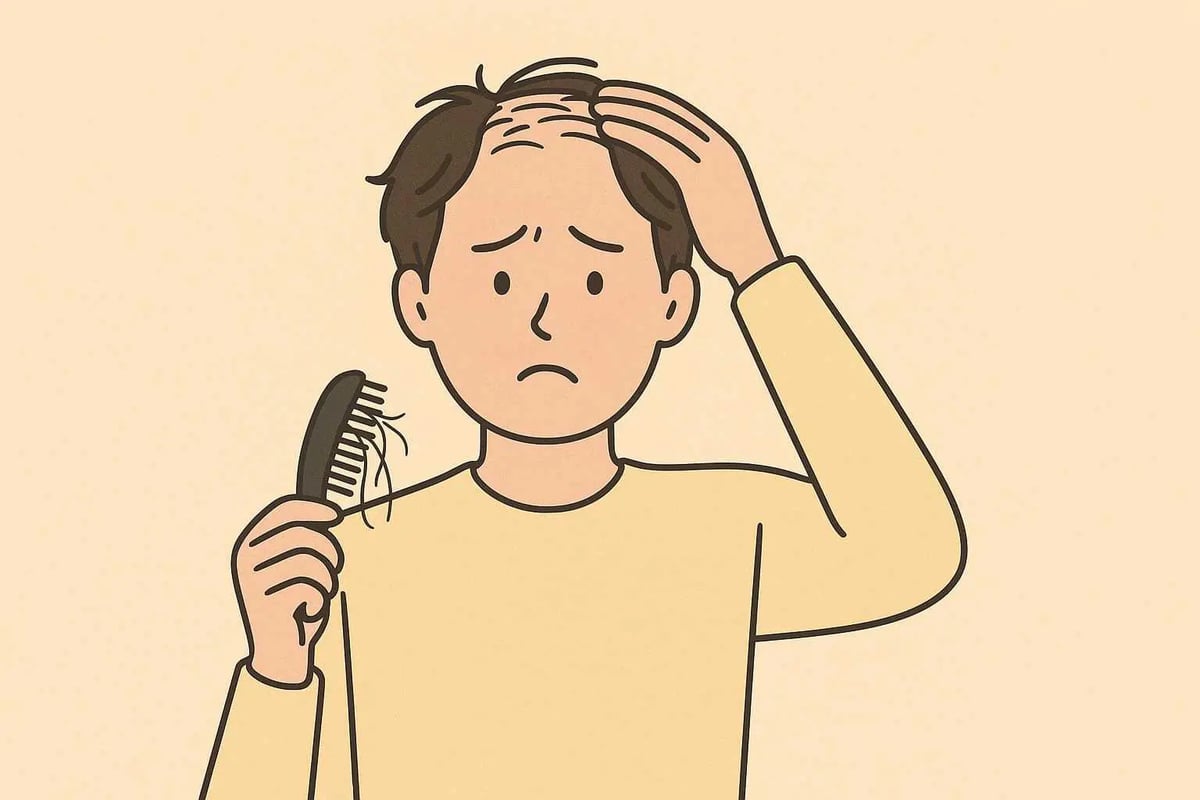
When hair loss starts young, people often jump straight to thinking about a transplant — but the first step is to work out the cause. Hair loss in young adults can be male pattern baldness, telogen effluvium, alopecia areata, or a scalp condition, and the direction of treatment differs greatly between them.
Key point: Young-adult hair loss should first be confirmed as male pattern baldness, telogen effluvium, alopecia areata, or a scalp condition. If shedding is rapid, patchy, or the scalp is red and painful, see a doctor early. A transplant only redistributes existing follicles; it is usually assessed by a doctor in person only after the cause is clear, the trend is relatively stable, and the donor area is sufficient.
What Are the Common Causes of Hair Loss in Young Adults?
The cause of hair loss cannot be judged by age or a photo alone. Receding at both temples, an M-shaped hairline, or gradual thinning at the crown may be male pattern baldness; but stress, illness, rapid weight loss, nutritional deficiency, medication, and scalp inflammation can also cause noticeable shedding.
Male pattern baldness is linked to a genetic tendency and the follicles’ sensitivity to androgen metabolites; an early onset does not mean it will necessarily worsen quickly, but it should be tracked regularly under fixed lighting, angle, and hair length to help the doctor judge the trend. Telogen effluvium usually shows as an overall drop in hair volume, appearing weeks to months after a fever, major stress, surgery, childbirth, rapid weight loss, or a change in nutrition. Sharply defined patchy loss, or loss with redness, pain, flaking, or pustules, should not be self-treated as male pattern baldness — it should be assessed by a dermatologist or hair specialist.
| Hair-loss pattern | Possible direction | Suggested next step |
|---|---|---|
| Receding M-shaped hairline, gradual crown thinning | Male pattern baldness | Track changes; doctor checks follicle miniaturisation |
| Marked overall drop in volume over a short period | Telogen effluvium or systemic factors | Review the past 2–4 months; test if needed |
| Round or patchy bald spots | Alopecia areata, traction, or other local lesion | See a doctor early to confirm the cause |
| Redness, pain, flaking, or pustules | Scalp infection or inflammation | Avoid scratching and self-medicating; see a doctor soon |
At What Point Should a Young Adult See a Doctor?
The amount of hair shed naturally each day fluctuates, and counting strands during a wash does not necessarily tell you whether there is a disease. Rather than fixating on a fixed number, watch whether the volume keeps dropping, whether the hairline or part is widening, and whether scalp symptoms are also present.
See a doctor sooner in these cases:
- The hairline, crown, or part keeps changing over months
- Sudden heavy shedding or a patch of missing hair
- A red, painful, itchy scalp, flaking, pustules, or crusting
- Fatigue, marked weight change, or other whole-body symptoms at the same time
- Still worsening after months of self-management
For the visit, prepare your family history of hair loss, current medication and supplements, recent illness or weight-loss records, and same-angle scalp photos. These help the doctor tell short-term fluctuation from ongoing progression.
How Can Young-Adult Hair Loss Be Improved?
The way to improve it depends on the diagnosis — no single method suits everyone with early hair loss. Male pattern baldness usually calls for a discussion of medication and long-term follow-up; for telogen effluvium the focus may be on the trigger; infection or inflammation needs matching treatment.
- Medication needs its indication and risks confirmed first: A doctor may assess topical minoxidil by sex, age, history, and loss type, or discuss prescription drugs such as finasteride or dutasteride for adult men. These can involve scalp irritation, early shedding changes, sexual function, fertility, and pregnancy-exposure considerations — whether to use them, the dose, and follow-up should follow the doctor’s advice and the latest package insert. Response is measured in months; do not raise the dose or mix regimens on your own just because there is no short-term change.
- Lifestyle changes are supportive, not a universal cure: Regular sleep, a balanced diet, enough protein, and avoiding rapid weight loss all support overall health; but without a clear deficiency, high-dose supplements should not be treated as therapy. Smoking, long-term tightly tied hairstyles, and harsh perming or dyeing can also add strain to the scalp or hair shaft.
- Tracking with photos and tests beats going by feel: Take photos monthly under the same lighting, angle, distance, and wet/dry state, and return for review as the doctor arranges; assessment looks at whether shedding is slowing, along with shaft thickness, density change, and side effects.
Are Young Adults Suited to a Hair Transplant?
Whether a transplant suits you cannot be decided by age alone. A transplant moves follicles from a donor area such as the back of the scalp to the thinning area; it cannot stop the un-transplanted native hair from continuing to thin, nor increase the total number of usable follicles a person has. So the younger you are, the more you need to preserve the future donor area — designing too low a hairline too early can create a visible gap and make repair difficult as the surrounding native hair keeps thinning.
Generally, further discussion is more suitable when the cause is confirmed, the trend is relatively stable, the thinning area is well defined, the donor area is sufficient, and the person understands they may still need medication, follow-up, or extra planning in future. Conversely, when loss is still progressing quickly, the diagnosis is unclear, the donor area is itself thinning, the expected density exceeds what the donor can supply, or the person is still in puberty, the cause should usually be treated and tracked first. As for FUE versus FUT, the two differ in harvesting method, scar type, obtainable follicle count, and recovery — the choice should be planned by a doctor after an in-person examination.
| Assessment item | Suited to discuss a transplant | Better to treat or observe first |
|---|---|---|
| Cause of loss | Clear diagnosis | Unclear cause, or suspected inflammatory/scarring loss |
| Progression trend | Relatively stable after follow-up | Rapid recession or spread within months |
| Donor condition | Density and quality can support the plan | Donor area is itself thinning |
| Expectations and long-term plan | Understands density limits, willing to keep following up | Expects one surgery to handle all future loss |
What Is the Right Order for Handling Young-Adult Hair Loss?
A safer order is diagnose first, then control, then rebuild. First confirm the type of loss and any reversible factors; those who need treatment follow up for a few months as directed, watching progression and response; if a fixed thinning area remains, then discuss whether a transplant can reach a reasonable goal within a limited donor supply.
When consulting about a transplant, feel free to ask about the estimated number of follicles, the safe donor range, hairline design, how the native hair may change in future, alternatives, possible risks, and post-op follow-up. Any treatment should be decided by your own history and examination results — not by online photos or age alone.
Is young-adult hair loss always male pattern baldness? +
Not necessarily. It is common, but telogen effluvium, alopecia areata, scalp infection or inflammation, rapid weight loss, and nutritional or thyroid factors can also cause shedding. A doctor judges by pattern, history, and examination.
Can a young adult just use minoxidil? +
Not necessarily. Topical minoxidil may suit some types of loss, but scalp condition, how it is used, possible irritation, and the need for ongoing treatment all matter. Long-term self-use before the cause is clear is not advised — consult a doctor first.
Can young adults have a transplant? +
It cannot be decided by age alone. A doctor assesses the diagnosis, how stable the loss is, the donor condition, hairline design, and long-term progression. If loss is still rapid or the cause is unclear, treatment and follow-up usually come first.
Will I stop losing hair after a transplant? +
No. Transplanted follicles differ from the surrounding native hair, which can keep thinning due to the original condition. A transplant cannot stop all future loss, so plan the long-term donor supply and discuss whether ongoing treatment and follow-up are needed.
Related articles
This article has been reviewed and medically approved by Dr. Wen-Yi Wu

Dr. Wen-Yi Wu|Director, Mong Hair Clinic
- ● Fellow of ISHRS (FISHRS)
- ● ABHRS Board-Certified Hair Restoration Surgeon
- ● President of TSHRS (Taiwan Society of Hair Restoration Surgery)