
How Many Grafts Do You Need? The Formula, Density, and Donor Supply
“How many grafts do I need?” is the most common question at a consultation, but the answer is not a single fixed number. First, be clear: one “graft” is a natural follicular unit that may hold 1–4 hairs (or a varying number) — so 2,000 grafts is not 2,000 hairs.
Key point: The rough formula is transplant area × planned density, but density is not a fixed standard, and more is not better. After estimating, you still need to check the donor area, safe harvest range, calibre, native hair, and long-term loss, then have a professional doctor confirm in person. When clinics’ estimates differ widely, compare the marked area, per-zone density, and the definition of graft vs hair — not just the biggest number or lowest unit price.
What Is the Difference Between a “Graft” and a “Hair”?
A transplant usually counts in follicular units (grafts). One graft may hold a single, double, or multiple hairs, so 2,000 grafts is not 2,000 hairs, and you cannot convert to everyone’s total hair count with a fixed multiplier. The front of the hairline often needs more single-hair grafts, while areas needing visual coverage can use double- or multi-hair grafts along the flow. So a plan looks not only at graft count but at how the different units are distributed.
| Counting unit | What it means | Reading limit |
|---|---|---|
| Graft | A complete follicular unit, may hold a varying number of hairs | The same graft count does not mean the same total hairs or visual density |
| Hair | The number of single shafts | Does not directly reflect how many harvest/placement steps |
| Density per cm² | Grafts planned for a given area | Must be assessed with native hair, blood supply, scarring, and safe spacing |
How Is the Count Calculated? The Basic Formula
A rough estimate can be written as: total grafts ≈ Σ [each zone’s area (cm²) × each zone’s planned density (grafts/cm²)] — that is, calculate the hairline, forehead, mid-scalp, and crown separately and add them up. In practice, the whole scalp is not given one single density. Note that the formula gives a planning starting point, not a guaranteed value — hairline height, spacing of existing hair, scalp scarring, the technique, and donor limits can all make the final recommendation higher, lower, or split into stages.
| Example scenario | Area × planned density | Formula estimate | How to read it |
|---|---|---|---|
| Small temple area | 30 cm² × 30 grafts/cm² | ~900 grafts | Still depends on left-right depth, single-hair needs, and hairline height |
| Frontal rebuild | 60 cm² × 35 grafts/cm² | ~2,100 grafts | Density can differ between the front edge and the transition zone |
| Front to mid-scalp | 100 cm² × 30 grafts/cm² | ~3,000 grafts | If donor is limited, the scope, priority, or staging may change |

How Is Area Measured Objectively, and Is There a Fixed Density Standard?
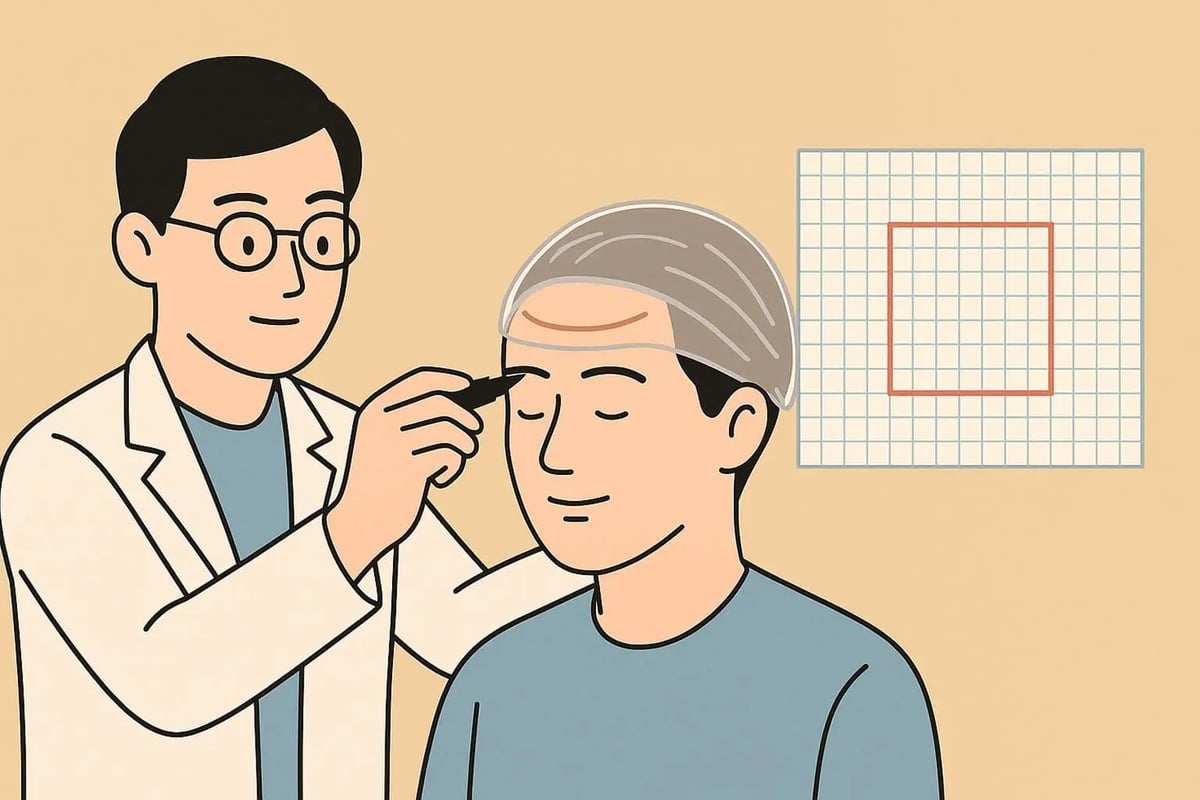
Measuring the area — the doctor first marks the planned hairline and each recipient border, then estimates square centimetres with grid paper, transparent tracing, digital imaging, or other means. The curved scalp, the whorl, and sparse zones among native hair make simple flat eyeballing inaccurate. Online photos suit only directional discussion (easily affected by angle, hair length, humidity, and lighting); a formal quote and surgical plan should still rely on on-site measurement, dermoscopy, and the doctor’s marking.
Density standard — there is no fixed number that suits everyone. Consultation material often shows a range like 30–45 grafts per cm², but this is only a reference, not a target every zone must reach, and a higher number is not safer or more natural. Factors affecting planned density include: zone and hair flow (hairline / forehead / mid-scalp / crown each allocated differently), native-hair density (densification must keep safe spacing, not just fill gaps), scalp and scar condition, the ratio of single- to multi-hair grafts, and calibre, curl, and hair-skin contrast.
How Does Donor Supply Limit the Count — and Is More Always Better?
The count cannot be worked backward from recipient need alone; the safe donor range at the back and sides must also be confirmed. The doctor looks at follicle density per cm², calibre, miniaturisation, past harvest marks, and scalp laxity, then estimates the one-time and long-term available amount. Over-harvesting can leave the donor area uneven or visibly sparse and reduces the resources for future ongoing loss. If need exceeds safe supply, reasonable options may be raising the hairline, narrowing coverage, prioritising the forehead, lowering the target density, or staging the surgery.
Also, the same graft count can look very different — visual coverage depends on calibre, curl, hair and skin colour contrast, flow angle, and native hair, not just the count. Thick or naturally wavy hair covers more per graft; fine straight hair or strong hair-skin contrast lets the scalp show more easily. Distribution matters too: the same count concentrated at the front builds a clearer facial frame, while spread evenly across front, mid, and crown lowers density in each. So more is not better — exceeding the safe range thins the back, and over-dense placement in the recipient area can add tissue strain or harm native hair.
How Many Grafts Do Different Balding Extents Usually Need?
The graft ranges seen online only help you understand the scale of surgery — they are not a remote diagnosis or a fixed quote. M-shape temple depth, hairline height, crown diameter, and whether the forehead still has native hair all shift the range greatly. The following is only an order-of-magnitude guide:
| Common extent | Rough graft scale | Variables most needing on-site check |
|---|---|---|
| Small hairline / temples | ~ a few hundred to ~1,500 | Hairline height, left-right depth, single-hair ratio |
| Moderate M-shape / forehead | ~1,500–2,500 | Whether it extends to mid-scalp, native density, future progression |
| Forehead plus mid-scalp | ~2,500–4,000 | Donor capacity, priority, and whether to stage |
| Large area or with crown | May exceed 4,000 or need staging | Safe donor supply, technique, health, long-term plan |
What Should You Ask About Graft Count at a Consultation?
A quote should not be just one number. Feel free to ask:
- Is the quote in grafts, hairs, or another unit?
- How many cm² are estimated for the hairline, forehead, mid-scalp, and crown, and the planned density and reason for each?
- How many single-, double-, and multi-hair grafts are expected?
- How are donor density, miniaturisation, and safe harvest amount measured?
- If the actual grafts obtained fall short or exceed, how is it handled and billed?
- How much donor resource is kept for when native hair keeps thinning in future?
- If a one-time procedure is not suitable now, what staged or non-surgical options exist?
A responsible assessment should explain the basis and limits of the calculation, not just give a seemingly precise number. If the cause of loss is unconfirmed and the donor area is also diffusely sparse, complete the diagnosis and treatment assessment first. Graft count is a “planning outcome,” not a target to chase on its own.
Can grafts and hairs be converted directly? +
Not by a fixed ratio. Each graft may hold 1, 2, or several hairs, so your own follicle composition must be counted; the quote and surgical record should first confirm whether it is grafts or hairs.
Can a graft count be quoted from a photo? +
A photo can only roughly estimate the range and is easily affected by angle, lighting, hair length, and parting. The formal count still needs on-site marking, area measurement, and a donor check by a professional doctor.
Is there a fixed density standard per cm²? +
There is no fixed density that suits everyone. The common range (about 30–45 grafts/cm²) is only a reference and is adjusted for zone, native hair, calibre, flow, scalp condition, and safe spacing.
Are more grafts always better? +
No. Over-harvesting thins the donor area, and over-dense placement can add risk. A reasonable count balances safe supply, visual priority, and future loss, as assessed by a doctor.
Related articles
This article has been reviewed and medically approved by Dr. Wen-Yi Wu

Dr. Wen-Yi Wu|Director, Mong Hair Clinic
- ● Fellow of ISHRS (FISHRS)
- ● ABHRS Board-Certified Hair Restoration Surgeon
- ● President of TSHRS (Taiwan Society of Hair Restoration Surgery)