

How Long Does a Hair Transplant Take? Process, Pain, and Anaesthesia
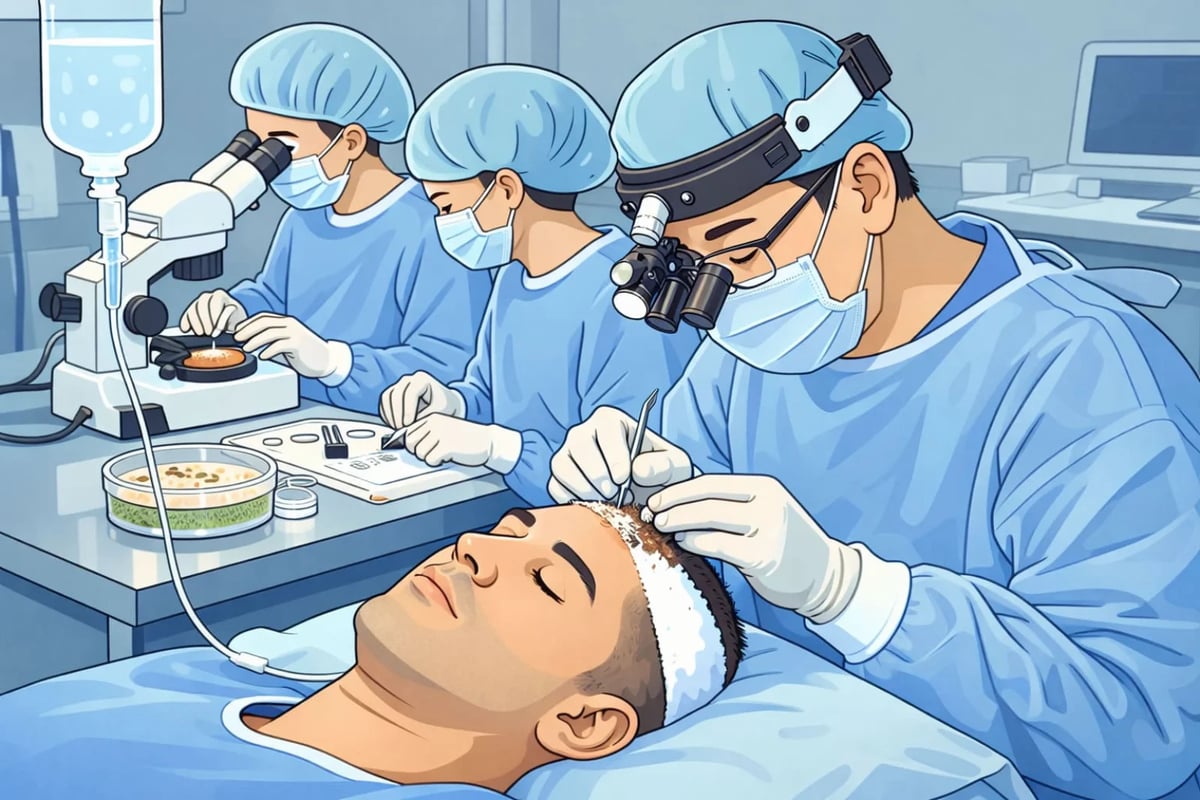
“How long does the surgery take? Will it hurt a lot? Do I really need anaesthesia? Am I awake during it?” These are the questions people with hair loss most want answered before deciding on a transplant.
Key point: For a standard follicular-unit transplant, with a smooth process and a full team, surgery can usually be completed in 4–6 hours. It uses local anaesthesia, and once the anaesthetic takes effect there is virtually no pain; you stay awake during the procedure, but in the implantation stage a mild sedative can be given, if the doctor assesses it’s appropriate, to help you relax. Below, we answer the duration, pain, anaesthesia, and what actually happens during surgery, point by point.
How Long Does the Surgery Take?
The duration mainly depends on three factors: the number of follicular grafts implanted, the technique used (FUT or FUE), and the size and division of labour of the team actually performing the surgery.
For a standard FUT follicular-unit transplant, with a smooth process and a full team, it can usually be completed in 4–6 hours. If a larger number of grafts is implanted, or the case involves a finer hairline design, the time may be slightly longer — but overall it remains a predictable, controllable schedule.
| Item | Detail |
|---|---|
| Typical duration | Standard follicular-unit transplant ~4–6 hours |
| Factors | Graft count, FUT/FUE technique, team size and roles |
| Longer cases | Many grafts, or a fine hairline design |
| Anaesthesia | Local (not general) |
| Awareness | Awake throughout; mild sedation possible during implantation |
Does It Hurt a Lot?
This is one of the questions patients ask and worry about most. In reality, once the anaesthetic has fully taken effect, there is virtually no pain during the procedure.
The only noticeable sensation usually comes at the very start, when the local anaesthetic is injected — a brief, stinging “ant-bite”-like feeling. But the doctor only begins harvesting and implantation after confirming the anaesthetic has fully taken effect, so during the surgery itself most patients are relaxed and comfortable.
Is Anaesthesia Required? Which Kind? Am I Awake?
Yes, a transplant always involves anaesthesia — but rest assured, it uses local anaesthesia. Its advantages include: no general anaesthesia, none of the associated risks, faster post-op waking and recovery, and high safety suitable for the vast majority of patients. In international hair-transplant standards, local anaesthesia has long been the mainstream, mature approach.
Because it’s local, the patient stays awake during surgery. However, in the “implantation stage,” which can last several hours, the doctor will usually — after a safety assessment — give a mild sedative to help the patient relax and not feel bored or tired. Many patients’ actual experience is: they nap and wake up to find the transplant already mostly done, or near the end, which actually eases the psychological burden.
What If I Need the Bathroom or a Break Mid-Surgery?
This is another thing many patients quietly worry about beforehand but feel too shy to ask. In reality, in most cases the surgery can be paused for a few minutes — whether you need the bathroom, want a short break out of nervousness or habit, or even have a cigarette craving, you can simply tell the doctor or nursing staff, and the team will pause the surgery, help you handle it, and then continue.
That’s because keeping the patient relaxed and stable actually helps the quality of the surgery. So there’s no need to grit your teeth and hold on — speaking up when you need to is completely normal.
How long does a transplant usually take? +
Most take about 4–6 hours; the actual time varies with graft count and technique.
Does it hurt? +
Under local anaesthesia the procedure is virtually painless, with only a brief stinging sensation when the anaesthetic is first injected.
Do I need general anaesthesia? +
No. A transplant uses local anaesthesia, which is very safe and carries none of the risks of general anaesthesia.
Am I awake during surgery? +
Yes, but a sedative can be used as needed during the implantation stage to help you relax or even doze off.
Can I use the bathroom during surgery? +
Yes. Just tell the doctor — the surgery can pause for a few minutes without affecting its safety.
Related articles
This article has been reviewed and medically approved by Dr. Wen-Yi Wu

Dr. Wen-Yi Wu|Director, Mong Hair Clinic
- ● Fellow of ISHRS (FISHRS)
- ● ABHRS Board-Certified Hair Restoration Surgeon
- ● President of TSHRS (Taiwan Society of Hair Restoration Surgery)