

Visible Scalp After a Hair Transplant: Lighting, Wet Hair and Density
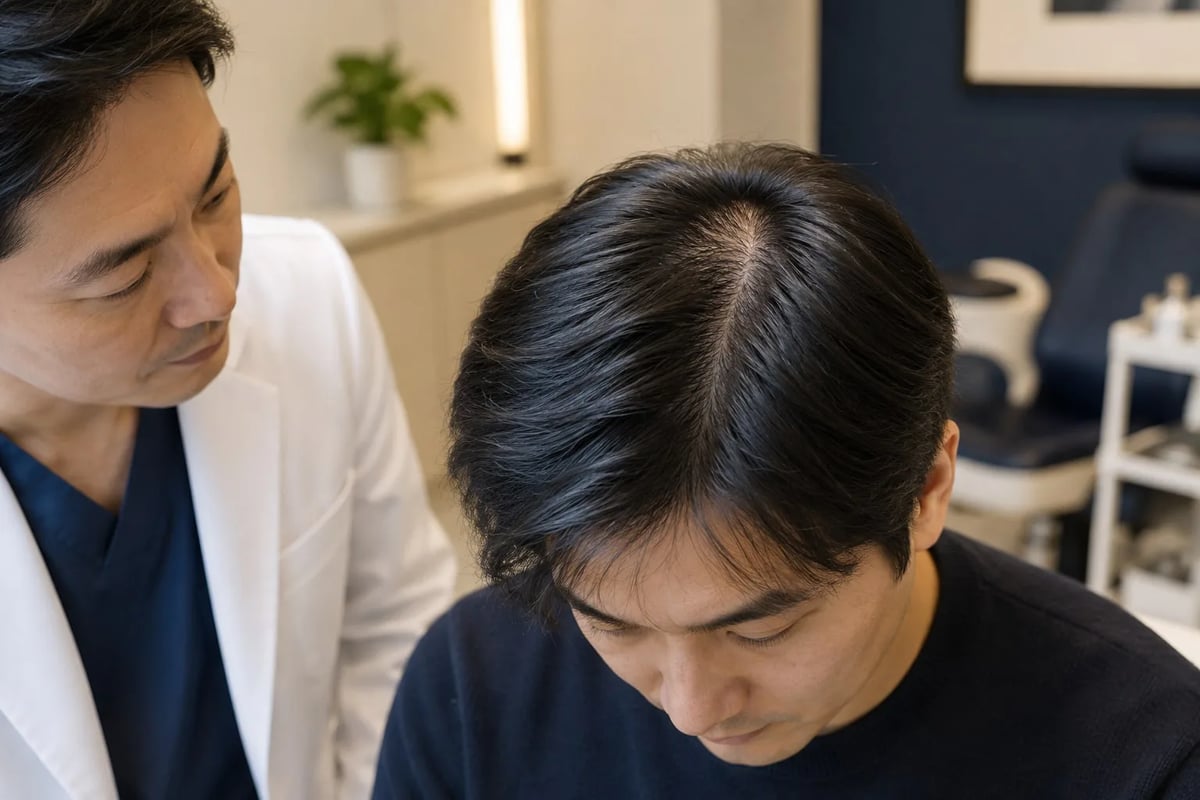
Seeing some scalp after a hair transplant does not automatically mean that follicles failed to grow. A hair transplant redistributes a limited donor supply; it cannot normally recreate the original number of follicles in a bald area. Overhead light, wet hair, a short haircut, parting and colour contrast can all change apparent density.
First consider how long it has been since surgery. Compare photographs taken with similar lighting, angle, hair length and wet or dry condition. A persistent sparse zone after the expected growth period, or a sudden change with redness, pain or scaling, needs examination.
Key point: scalp visibility is a visual-density question, not a direct measure of graft count or survival. Standardise the viewing conditions, then consider timing, calibre, direction, native hair and donor limitations together.
Why can the scalp remain visible after a hair transplant?
Transplantation creates visual coverage rather than restoring pre-hair-loss follicle density. The larger the recipient area and the more limited the donor supply, the more carefully coverage must be prioritised across the hairline, frontal zone, mid-scalp and crown.
Hair calibre and the number of hairs within each follicular unit also matter. Coarser, wavy hair overlaps more readily; fine straight hair and strong hair-to-skin colour contrast can reveal more scalp even when graft counts are similar.
| Possible reason | Typical appearance | How to check |
|---|---|---|
| Growth is incomplete | Zones grow at different rates and hairs remain short or fine | Follow serial photographs by postoperative month |
| Photography or styling differs | More scalp under overhead light, with wet or short hair | Match lighting, angle, length and dry-hair condition |
| Calibre and colour contrast | Fine straight strands or high contrast | Examine calibre and appearance in ordinary light |
| Native hair is miniaturising | Transplanted hair remains while the surrounding area thins | Compare older photographs and use trichoscopy |
| Growth is below expectation | A fixed sparse zone remains after maturation | Review the treated area, records and scalp clinically |
How much do lighting, wet hair and hair length affect visibility?
Strong overhead light reaches the scalp directly. Water, sweat and oily products make strands clump together and reduce their spread, while short hair provides less overlap than longer hair.

Close wide-angle photographs, sharpening and high contrast can magnify spaces between hairs. A wet-hair image under a bathroom light should not be compared directly with a dry-hair photograph taken under soft clinic lighting.
| Condition | Scalp may look more visible | Better tracking method |
|---|---|---|
| Lighting | Strong overhead light or flash | Same position with soft, even light |
| Wetness | Wet, sweaty or oily strands clump | Photograph fully dry hair |
| Length and styling | Short hair, wide part or reverse brushing | Keep length and direction similar |
| Angle and distance | Very close top-down view | Fix distance and repeat front, upper and crown views |
| Image processing | High contrast, sharpening or filters | Keep the original image without filters |
How should photographs be taken for a useful comparison?
Use the same location, time of day, light source and camera distance. Keep hair length, parting and dry-hair condition similar, and record frontal, side, upper, crown and donor views rather than only the most concerning angle.

Keep the original files and avoid concealers, fibres and filters. Our one-year hair transplant review guide explains how photographs fit into a broader clinical assessment.
When can hair transplant density be judged?
Visible shafts may shed after implantation before follicles rest and begin a new cycle. Follicles do not all start growing on the same day, and new hairs need time to gain length and calibre. Uneven growth or scalp visibility in the early months may therefore still be part of recovery.
Around one year is often used for a fuller density and direction review, although the crown can require longer. See the hair transplant growth timeline for stage-by-stage context.
Does visible scalp mean poor graft survival?
No direct conclusion can be made. Scalp visibility is an overall appearance, whereas survival assessment asks which implanted units grew. Recipient area, calibre, hairs per unit and direction can make the same number of growing grafts look different.

If a fixed gap or marked unevenness remains after maturation, the doctor can compare the operative map, records and trichoscopy findings. Read more about hair transplant survival and failure assessment.
Can continuing native-hair loss make the transplant look thinner?
Yes. Transplantation does not stop pattern hair loss in nearby native follicles. Transplanted follicles may continue to grow while surrounding native hairs miniaturise, reducing the combined visual density.
The two populations should be assessed separately and the outer pattern compared over time. Medical treatment must be individualised to diagnosis, health, contraindications and preference; do not start or stop prescription treatment without medical advice.
Can another procedure add density?
Some patients can be assessed for additional grafting after growth and scalp recovery are complete, but the cause of visibility comes first. Another procedure will not necessarily solve a difference caused by light, wet hair or styling, and progressive native-hair loss requires a long-term plan.
When a fixed coverage limitation is confirmed, donor reserve, recipient scarring, existing direction and future zones must be considered. Our guide to repeat hair transplantation and graft limits explains these constraints.
Which changes require an earlier review?
If visibility changes only under a particular light or when hair is wet, begin with standardised photographs. Arrange an earlier examination if stable density declines over weeks or months, a sharply defined gap appears, or there is persistent redness, pain, itching, scale, pustules, crusting or scar change.
Dr Wen-Yi Wu: density must be assessed in context
I assess postoperative timing, standardised photographs, the recipient area, native hair, donor area and scalp examination together. A close photograph alone cannot establish success or failure. Dr Wen-Yi Wu directly conducts medical consultations, surgical planning and postoperative assessment at Taiwan Hair; a non-medical sales consultant does not replace the doctor’s judgement.
ABHRS Diplomate and ISHRS FISHRS credentials can help patients verify education and professional participation, but they do not guarantee a particular density or outcome. This article provides general medical information and cannot replace an individual diagnosis.
References
Is visible scalp under strong light normal after a hair transplant? +
It can be. Strong overhead light highlights gaps between strands. Hair calibre, length, parting, postoperative stage and appearance in ordinary light must also be considered; one photograph cannot establish the result.
Why does wet hair look thinner than dry hair? +
Water and oil cause strands to clump together, reducing their spread across the scalp. Compare density only when hair is fully dry and length, lighting, angle and styling are similar.
How many months after a hair transplant can density be assessed? +
Follicles enter growth at different times, and new hairs need time to gain length and calibre. Around one year is often used for a fuller review, while the crown may require longer. Timing should be individualised.
Does visible scalp mean the transplant failed? +
Not necessarily. Lighting, wet hair, hair characteristics, recipient-area size, native-hair miniaturisation and the growth stage all affect appearance. A persistent local gap after the expected growth period needs medical assessment.
Can limited density be corrected immediately with more grafts? +
The cause should be established first, after growth and scalp recovery are assessable. Donor reserve, native-hair progression and future needs must be reviewed; another procedure may not help a lighting or styling issue.
When should I arrange an earlier review? +
Seek review for a sudden decline in density, a sharply defined patch, or persistent redness, pain, itching, scale, pustules, crusting or scar change.
Related articles
This article has been reviewed and medically approved by Dr. Wen-Yi Wu

Dr. Wen-Yi Wu|Director, Mong Hair Clinic
- ● Fellow of ISHRS (FISHRS)
- ● ABHRS Board-Certified Hair Restoration Surgeon
- ● President of TSHRS (Taiwan Society of Hair Restoration Surgery)