

How Many Hair Transplants Can You Have? Donor Limits and Repeat Surgery
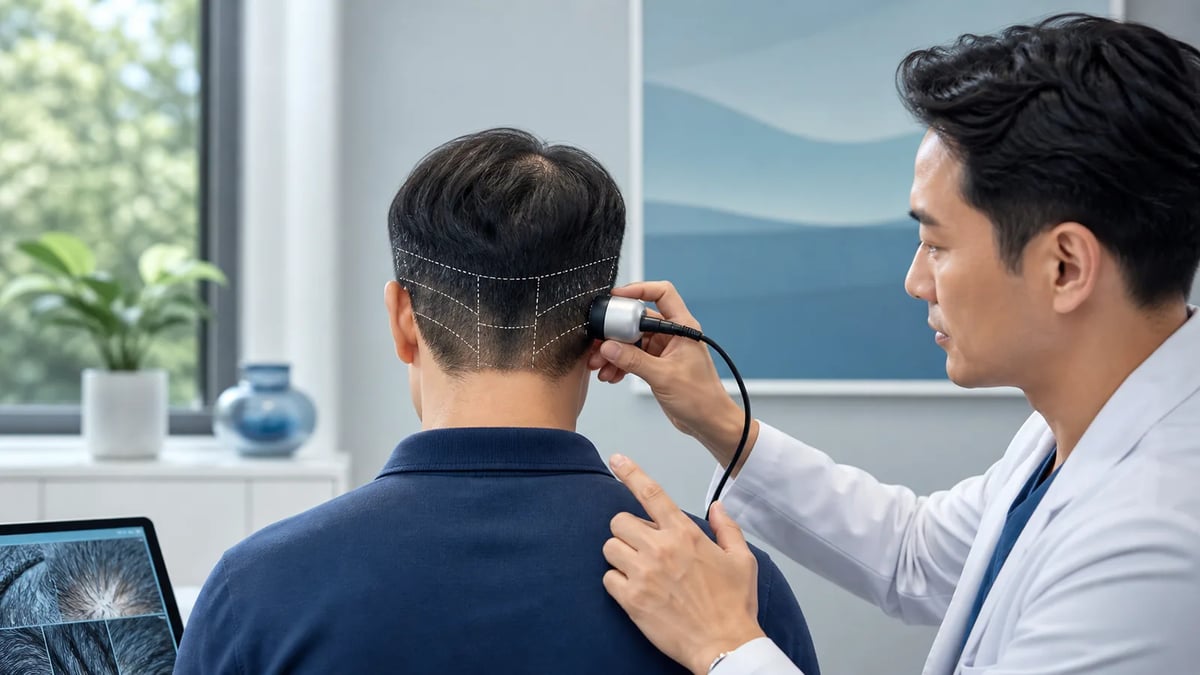
You can have more than one hair transplant, but there is no standard answer to “How many can everyone have?” The real limit is not your age or a clinic package. It is how many follicles can still be removed from a safe donor area without leaving the back and sides visibly depleted.
One operation may meet one person’s goals. Another may need a second or third because the area is extensive, native hair continues to miniaturise, or an earlier result needs refinement. Before every repeat procedure, the donor area should be measured again rather than treating the previous graft count as a lifetime allowance.
Key point: donor follicles are a finite resource. Repeat surgery must consider remaining density, previous harvesting patterns, future loss and where the next grafts will create the most useful coverage. A larger session is not automatically a better long-term plan.
Five Factors That Limit the Number of Hair Transplants
1. The size and density of the safe donor area
Not every hair at the back and sides is guaranteed to remain stable. The surgeon first defines the zone least likely to be affected by progressive pattern loss, then checks follicular-unit density at multiple points, hair calibre, the proportion of multi-hair units and signs of retrograde or diffuse thinning.
Hair-transplant practice guidelines recommend a detailed physical and trichoscopic assessment of donor quality and warn against overharvesting with FUE. A 580-person donor-zone study likewise showed that donor dimensions and estimated harvestable supply vary substantially, so one headline number should not be applied to everyone.
2. How the area was harvested before
A note saying “2,000 grafts were taken” is only part of the history. The surgeon also needs to inspect whether extractions were clustered, whether there is window-like thinning, the width of scars, scalp laxity and the calibre of what remains. An uneven pattern can reduce future options even when the recorded graft count seems modest.
3. How far hair loss may progress
Transplanted hairs usually retain the characteristics of their donor site, but surrounding native hair may continue to miniaturise. Younger patients, people with an unstable pattern and those with extensive family history often need a conservative hairline and a reserve for the mid-scalp or crown.
4. The area, density goal and hair characteristics
The same bald area can require a different visual plan when hair is fine or straight, or when there is strong contrast between hair and scalp. Graft count is a planning tool, not a guarantee. Our guide to calculating hair-transplant graft numbers explains the estimate, but donor capacity still sets the ceiling.
5. Harvesting method and scalp condition
FUE, FUT and combined approaches use the donor area differently. FUE removes units across a wider field, so extraction percentage and distribution matter. FUT produces a linear scar and is constrained by scalp laxity and previous scars. See FUE, FUT and COMBO compared for the broader trade-offs.
One Larger Session or Staged Surgery?
A larger single session may reduce travel and the number of operations, but operating time, graft storage, recipient-site blood supply, wound care and team capacity also matter. Staging allows the surgeon to observe native-hair progression and the distribution of growth before allocating the next set of grafts.
| Consideration | Larger single session | Staged procedures |
|---|---|---|
| Often considered when | Donor supply is suitable, the target is clear and fewer trips are important | Loss may progress, the area is extensive or flexibility is valuable |
| Advantage | Treats a broader area in one operation | The next distribution can respond to growth and ongoing loss |
| Limitation | Longer procedure and greater one-session load on donor and recipient sites | Another operation and recovery period are required |
| Key assessment | Safe one-session harvest, distribution and graft handling | Timing, remaining supply and the next priority area |

Do FUE, FUT and COMBO Change the Number of Possible Operations?
They change how the resource is used, but do not by themselves produce a fixed number.
| Harvesting method | Donor-planning focus | What to reassess before repeat surgery |
|---|---|---|
| FUE | Distribute excisions and preserve enough visual density | Dot-scar pattern, remaining density, calibre and short-hair appearance |
| FUT | Harvest a strip while preserving surrounding donor hair | Scalp laxity, linear-scar width and safely removable tissue |
| COMBO | Integrate both sources in one or staged sessions | Limits of each method and total remaining supply |
Published guidance notes that FUE reduces density across the harvested field, which must be considered before another pass. Surgeons may discuss combined harvesting for selected large, revision or donor-limited cases, but this also makes planning and surgery more complex.
What Should Be Checked Before a Second Hair Transplant?
The previous graft growth, scalp and scars should first reach a stage that can be judged reliably. The appropriate interval depends on the extent of surgery, healing and changes in native hair; an online fixed-month rule cannot replace follow-up.
Bring the previous operation date, method, graft count, extraction map if available, and comparable photographs. The assessment should cover:
- donor density, calibre, scars and the distribution of extraction points
- actual growth, direction and density variation in the recipient area
- continuing miniaturisation and whether treatable hair loss should be addressed first
- scalp inflammation, scarring or other conditions that may affect surgery
- the area that deserves priority now and the reserve needed for later
Our hair-transplant consultation checklist can help you prepare the records and questions.
What If the Scalp Donor Supply Is Too Limited?
Further harvesting from an inadequate safe zone can leave thinning that is difficult to conceal. A safer plan may reduce the target area or density expectation, place the remaining grafts where they offer the greatest visual benefit, and consider treatment for native hair, styling or non-surgical options.
Beard or other body hair can be a supplementary source in selected cases, but it differs in growth cycle, calibre, curl and maximum length. It is not an equal substitute for scalp hair. Read the detailed limitations in our beard and body-hair transplant guide.

Hair transplantation is long-term resource allocation, not a competition over sessions or graft counts. A sound plan protects the donor area first, then decides how much to do and where. This article provides general education and does not replace an in-person diagnosis or surgical advice.
References
Can I have a second or third hair transplant? +
Possibly, if the safe donor area still has enough density and the previous donor and recipient sites have recovered enough to assess. A fresh examination is needed before every procedure; the last graft count alone cannot predict eligibility.
What is the maximum number of grafts available over a lifetime? +
There is no fixed number that applies to everyone. The safe amount depends on donor-area size and density, hair calibre, follicular groupings, future loss, harvesting method and previous surgery. It must be measured individually.
Does transplanting more grafts in one session always give a better result? +
No. Visual coverage also depends on hair calibre, direction, hair-to-scalp colour contrast, native hair and placement. Aggressive harvesting for a higher number can leave visible donor thinning.
How long should I wait before a second transplant? +
There is no universal interval. The previous growth, scalp and scars need to be mature enough to assess, after which the surgeon considers the treated area, native-hair changes and the new objective.
Do FUE and FUT affect how many procedures I can have? +
They affect how the donor area is used, but the technique name alone does not determine a number. FUE assessment focuses on extraction distribution and remaining density; FUT also depends on scalp laxity and the linear scar.
Can beard or body hair help when the scalp donor area is limited? +
It can supplement scalp hair in selected cases, but its cycle, calibre, curl and maximum length differ. It is not a like-for-like replacement and requires an experienced individual assessment.
Related articles
This article has been reviewed and medically approved by Dr. Wen-Yi Wu

Dr. Wen-Yi Wu|Director, Mong Hair Clinic
- ● Fellow of ISHRS (FISHRS)
- ● ABHRS Board-Certified Hair Restoration Surgeon
- ● President of TSHRS (Taiwan Society of Hair Restoration Surgery)