

How to Take Hair Transplant Consultation Photos: 5 Essential Views
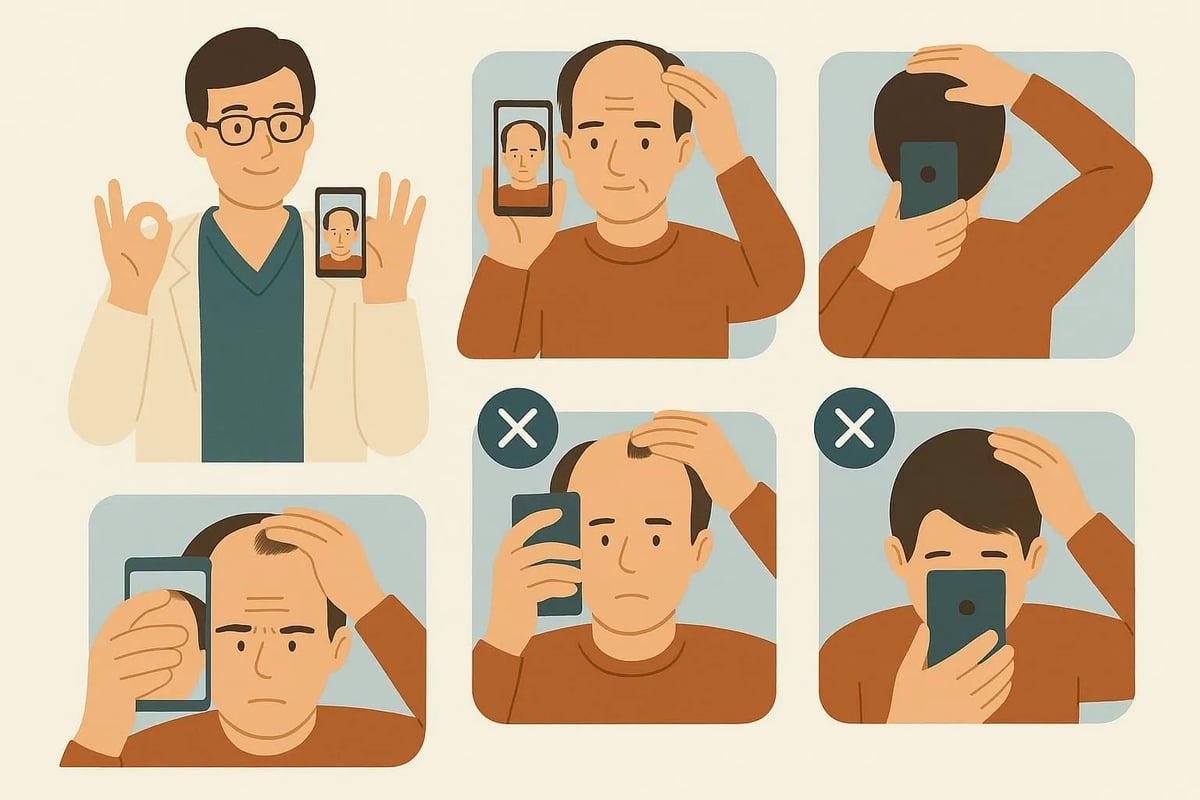
Online hair transplant consultation photos should show the complete hairline, top of the scalp and donor area rather than one close-up patch. Good photographs help the doctor understand your concern, but they cannot replace examination of the scalp, follicles and donor supply.
Key point: start with five views — front, left temple, right temple, top and back. Photograph dry, naturally arranged hair in even light, using the normal camera mode with all beauty and hair-enhancement filters disabled. A qualified doctor must still assess the graft plan, donor capacity, technique and price.
Which five views should you photograph?
Each image should include enough of the head to show where the thinning area sits. The top and back are difficult to frame alone, so asking someone to help often produces a clearer result than an awkward selfie.
| View | How to take it | What it should show |
|---|---|---|
| Front | Keep the head level and gently move the fringe | Full forehead, hairline and both corners |
| Left temple | Turn slightly right | Left corner, temporal hairline and surrounding hair |
| Right temple | Turn slightly left | Right corner, temporal hairline and surrounding hair |
| Top | Lower the chin slightly; photograph from above | Frontal scalp, mid-scalp and crown in one frame |
| Back | Photograph straight from behind; remove hats or collars | Occipital and side donor areas, not a tiny close-up |
Add a closer crown image if that is your main concern, but retain the orientation view. Photos support initial communication; our hair transplant evaluation guide explains what an in-person assessment adds.
How can you avoid making density look misleading?
Photograph dry hair in its usual arrangement. Do not apply hair fibres, scalp concealer or style the hair specifically to hide thinning. Tell the doctor if you normally use these products, and do not shave solely for the photographs.
Clean the phone lens and use the standard camera mode. Disable beauty filters, portrait blur and automated hair enhancement. Light should fall evenly from the front or above; avoid backlighting, harsh reflections and a strong shadow across one side.
The American Academy of Dermatology likewise advises sharp focus, suitable lighting, filters turned off, and a combination of orientation, comparison and close-up photographs for remote clinical review.
Which common mistakes mean the photos should be retaken?
Many copies of the same view are less useful than a complete set. Zoom in before sending and check that hair and scalp edges are sharp and that the messaging app has not reduced the files to tiny thumbnails.
| Common problem | Why it matters | Better approach |
|---|---|---|
| Blurred image or focus on the background | Hair shafts, scalp and hairline are unclear | Tap the head to focus and inspect the saved image |
| Extreme close-up only | The location and full extent are missing | Take an orientation view before a detail view |
| Front view only | Top thinning and donor appearance are not shown | Add top and rear views |
| Backlight, flash glare or beauty filter | Scalp and hair detail may be hidden | Use even light and disable image effects |
| Wet hair, fibres or deliberate concealment | Appearance differs from the usual dry state | Photograph natural dry hair and disclose products |
What can photographs assess initially?
Clear photos can show the visible pattern across the hairline, temples, frontal scalp, mid-scalp, crown and rear donor area. Older images taken under similar lighting, angle and hair length may also help illustrate a trend.

An online consultation may provide direction, but it should not be presented as a definitive diagnosis, guaranteed outcome or formal surgical quotation. Use our pre-operative consultation question list to prepare for the next discussion.
Why can photos not determine the final graft count or price?
Photographs cannot fully measure the curved recipient area, follicular density per square centimetre, hair calibre, miniaturisation, scalp laxity, inflammation or scarring. A donor area that looks dense in one image cannot be converted directly into a safe harvest number.
The doctor must measure the recipient area and consider the planned hairline, native hair, donor reserve and likely future loss. How many grafts a hair transplant needs explains the role and limitations of area-density calculations; the hair transplant overview covers techniques and suitability.
What information should accompany the photos?
Pair the image set with a short history:
- Your age, main concern and approximate duration of hair loss.
- Any sudden shedding, itching, redness, scaling, pain or discharge.
- Current prescription medicines, non-prescription products, supplements and scalp treatments.
- Previous hair transplantation, scalp procedures, blood tests or diagnoses.
- The date of older photographs and any differences in hair length, parting or light.
Sudden heavy shedding, round bald patches, pain, inflammation or discharge should be raised clearly and assessed by a doctor rather than handled only as a request for a photograph-based price.
How should you send the images privately?
Scalp and facial photographs are personal health information. Ask the clinic which private channel it uses, whether facial proportions need to remain visible, and which parts may be covered. Do not post consultation images in public comments or on social media.
After the initial review, the doctor may request more images, a video appointment or an in-person visit. The purpose of a good photo set is to make the first conversation more specific, not to reduce medical assessment to a single picture.
References
Can I use a phone for hair transplant consultation photos? +
Yes. Use the normal camera mode, clean the lens, turn off beauty filters and keep the image evenly lit and sharply focused. The doctor may still request more views or an in-person examination.
Do I have to send exactly five photos? +
No. The five views are a practical starting set, not a universal medical rule. Front, both temples, top and donor-area views show the overall pattern; the clinic may ask for additional angles.
Should I wash or shave my hair before taking the photos? +
You generally do not need to shave for photographs. Take them with dry, naturally arranged hair and without hair fibres or concealer. Follow any specific instructions given by the clinic.
Why photograph the donor area if I only want the hairline treated? +
A transplant assessment considers both the recipient and donor areas. A rear photo is only an initial visual reference; density, calibre, miniaturisation and safe harvest capacity still require examination.
Can photos provide an exact graft count and price? +
Photos may support a preliminary discussion, but angle, hair length, lighting and scalp condition affect what can be seen. The final graft plan, technique and quotation require measurements and donor examination.
Can I hide my face in consultation photos? +
Ask the clinic which features are needed and what may be covered. Avoid hiding the hairline, temples or facial proportions required for planning, and send health images only through a private channel confirmed by the clinic.
Related articles
This article has been reviewed and medically approved by Dr. Wen-Yi Wu

Dr. Wen-Yi Wu|Director, Mong Hair Clinic
- ● Fellow of ISHRS (FISHRS)
- ● ABHRS Board-Certified Hair Restoration Surgeon
- ● President of TSHRS (Taiwan Society of Hair Restoration Surgery)