

Do Hair Transplants Leave Scars? FUE, FUT and Recovery
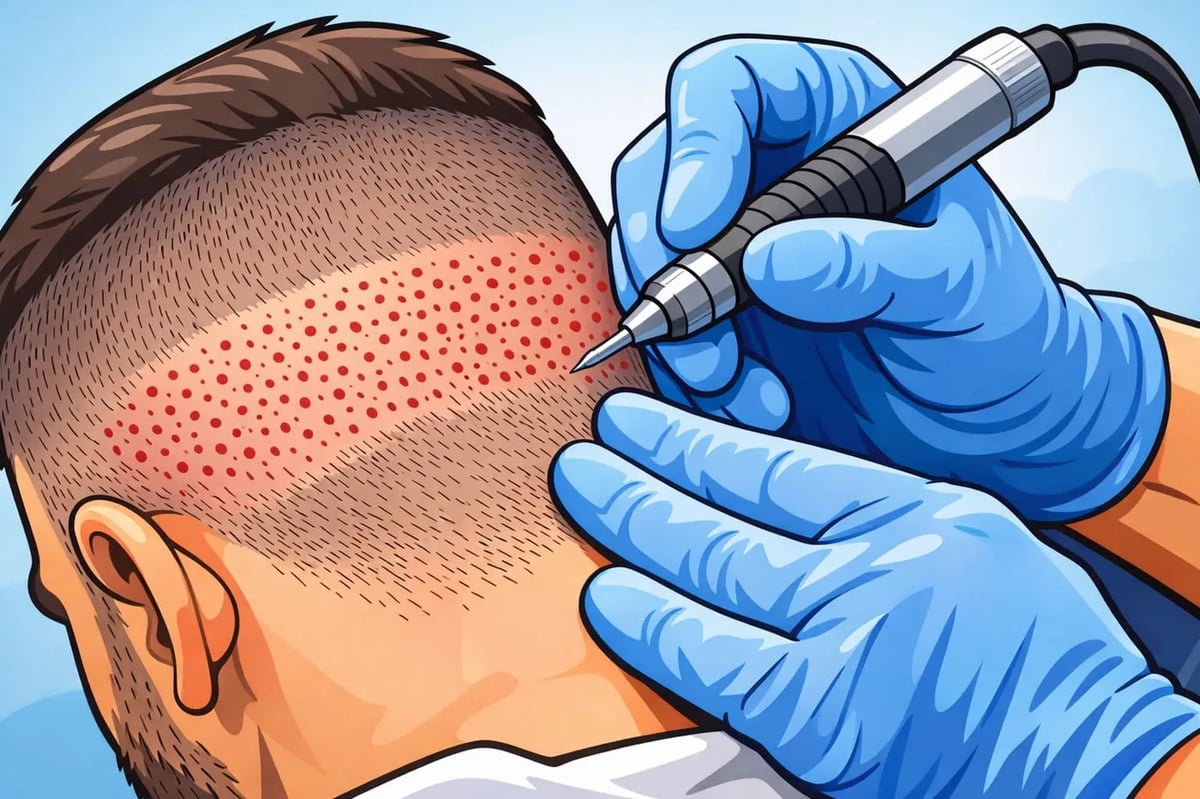
Yes. Any incision or punch injury enters a wound-healing process and forms scar tissue. The practical question is not whether a scar exists, but what pattern it takes and whether surrounding hair conceals it.
FUE usually leaves scattered dot scars, while FUT leaves a linear scar across the donor area. Visibility depends on hair length, skin-hair contrast, harvest density, wound tension, and individual healing.
Key point: FUE is not scarless. Its dots may show when the donor is shaved very short, while an FUT line needs enough hair to cover it. Overharvesting may also leave the donor thin or patchy.
Does every hair transplant leave a scar?
Hair transplantation removes follicles from a donor area and places them into the recipient area, so both FUE and FUT create wounds. Most patients are really asking whether the marks can be concealed and whether they will show with their preferred haircut.
Assessment should include donor density, usual hair length, future hair-loss pattern, and prior surgery. Read our main hair transplant guide for the overall process, limitations, and recovery.
| Feature | FUE | FUT |
|---|---|---|
| Harvest | Grafts removed one by one with punches | A strip is removed and divided into follicular units |
| Typical scar | Multiple scattered dots | One linear scar |
| With short hair | Dots or uneven density may show | The line may show if hair is too short |
| Planning focus | Distribution, density, and donor preservation | Scalp laxity, closure tension, and scar history |
How do FUE and FUT scars differ?

FUE: scattered dot scars
After graft-by-graft harvesting, FUE generally leaves many small dot scars. They may be difficult to notice under longer hair, but shaving, high skin-hair contrast, concentrated punches, or a high harvest can reveal pale dots or uneven donor density.

FUT: a linear donor scar
FUT leaves a line whose final width is influenced by scalp laxity, closure tension, wound care, and healing. Neither method is simply “old versus new” or “scar versus no scar.” Compare FUE, FUT, and COMBO selection by donor supply, hairstyle, graft need, and future planning.
Are transplant scars visible with very short hair or a shaved head?

They can be. FUE dots are more likely to appear when the donor is shaved close, while an FUT line needs sufficient length for coverage. No technique should promise that a fully shaved donor will look untouched.
Tell the doctor if you routinely wear a very short cut, expect to shave your head, or need the occipital hair clipped for work. That preference should influence harvest distribution and technique.
What makes donor-area marks more visible?
Technique is only one factor. Excessive or concentrated FUE harvesting can create a moth-eaten or patchy appearance. That reflects depleted and unevenly distributed donor follicles, not merely a surface scar.
| Factor | Possible effect |
|---|---|
| Hair length and contrast | Short hair and stronger contrast reveal marks more easily |
| Harvest density and spread | Concentrated or excessive removal may look sparse or patchy |
| FUT wound tension | Greater tension may contribute to a wider line |
| Personal scar response | Previous keloid or hypertrophic scars need disclosure |
| Infection, rubbing, or picking | May prolong inflammation and disrupt healing |
Smoking may also impair wound healing. Whether and when to stop should follow your medical history and surgical team’s advice; review our smoking and hair-transplant guidance.
How long does donor recovery and scar maturation take?
Early redness, swelling, crusting, tightness, or mild sensitivity can occur and should gradually settle. The timeline varies with technique, graft number, skin, and care, so a fixed day count cannot define recovery for everyone.
Scar colour and texture may continue changing for months. Early red dots or a visible line are not the final appearance. Follow the team’s washing, sleeping, activity, and review instructions; see the hair-transplant aftercare FAQ for general context.
Which signs need prompt medical review?
Mild early redness or crusting can be part of healing, but symptoms that worsen rather than improve should not simply be watched at home.
| Observation | Next step |
|---|---|
| Mild redness, swelling, or crusts that steadily improve | Follow cleaning and review instructions |
| Increasing pain, redness, warmth, or swelling | Contact the surgical team promptly |
| Pus, odour, or wound separation | Seek medical assessment quickly |
| Fever, chills, or marked systemic illness | Contact medical services urgently |
These are general warning signs used when assessing surgical-wound infection; see the NHS surgical-wound guidance.
Can someone with keloid or hypertrophic scars have a transplant?
This cannot be decided safely from an online photograph. If ear piercings, chest wounds, shoulder injuries, or previous surgery produced a raised, itchy, or progressively enlarging scar, disclose it and let the doctor examine the old scar.
Risk assessment considers the scar history, location, skin, donor area, and intended technique. Also disclose medicines, chronic illness, smoking, and prior recovery; use our consultation and pre-operative questions as a checklist.
What can be done if a hair-transplant scar is conspicuous?
First distinguish a widened line, dot hypopigmentation, donor overharvesting, active inflammation, and infection. They do not have the same treatment.
Once a scar is stable, options may include hairstyle changes, scalp micropigmentation, scar revision, or carefully selected grafting into the scar. Suitability and limitations vary, and no option can promise complete erasure.
This article provides general medical education and does not replace an in-person assessment. Technique, harvest extent, and wound care must be individualised by the treating team.
References
- Journal of Cutaneous and Aesthetic Surgery: Complications in Hair Transplantation
- Indian Journal of Plastic Surgery: Hair Transplant Practice Guidelines and Complications
- International Society of Hair Restoration Surgery: FUT Task Force Report
- Guy’s and St Thomas’ NHS Foundation Trust: Surgical wounds and preventing infections
Can a hair transplant be completely scarless? +
No procedure should be described that way. Both FUE and FUT create wounds and scars; the pattern, distribution, and visibility differ.
Can FUE scars be seen with a shaved head? +
They can. Shaving may reveal scattered pale dots or density differences, depending on skin-hair contrast, harvest density, distribution, and healing.
Is an FUT linear scar always wide? +
No. Width varies with scalp laxity, closure tension, wound care, and individual healing, so pre-operative assessment and follow-up matter.
Can someone prone to keloids have a hair transplant? +
This needs an individual medical assessment. Tell the doctor about any previous raised, itchy, or enlarging scars and show the old scars before surgery.
How long does a hair-transplant scar take to fade? +
Colour and texture may continue changing for months. Timing varies with technique, skin, graft harvest, and care, so there is no single universal deadline.
What should I do if the wound becomes red, swollen, and painful? +
Contact the surgical team promptly if redness, warmth, swelling, or pain worsens, or if there is pus, odour, wound separation, fever, or systemic illness.
Related articles
This article has been reviewed and medically approved by Dr. Wen-Yi Wu

Dr. Wen-Yi Wu|Director, Mong Hair Clinic
- ● Fellow of ISHRS (FISHRS)
- ● ABHRS Board-Certified Hair Restoration Surgeon
- ● President of TSHRS (Taiwan Society of Hair Restoration Surgery)