
Who Performs a Hair Transplant? Surgeon and Team Roles Explained
Hair transplantation is medical surgery. Diagnosis, candidacy, surgical planning, donor harvesting and recipient-site design require qualified medical judgment. A trained team may assist with graft preparation, instruments and patient care, but you should know who is responsible for every stage before surgery.
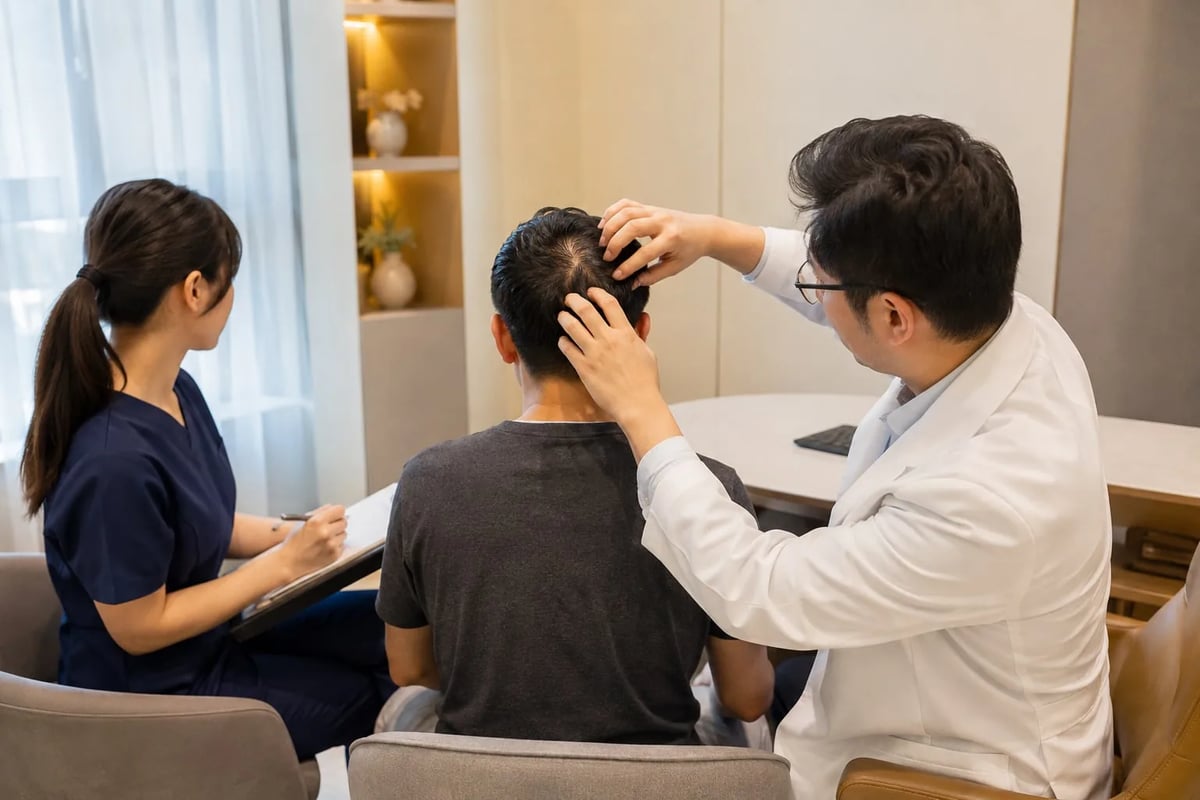
At Taiwan Hair Clinic, the hair-transplant consultation is conducted directly by Dr. Wen-Yi Wu—not by a non-medical sales consultant relaying a proposed plan. Patients can discuss the diagnosis, donor assessment, hairline design, technique and surgical limits with the same physician responsible for the operation.
The essential point: teamwork is normal, but the surgeon should not appear only for a photograph or a brief introduction. Before paying or consenting, verify the responsible physician, the operator for each surgical step, anesthesia and emergency arrangements, and who provides postoperative medical follow-up.
Why does hair transplantation require a team?
A procedure includes history-taking, scalp and donor assessment, hairline and density planning, anesthesia, graft harvesting, counting and preparation, recipient-site creation, implantation, wound care and follow-up. Because surgery can last many hours and harvested follicles must be handled efficiently, one person rarely performs every supporting task alone.
Teamwork itself is not the concern; unclear responsibility is. The physician remains accountable for diagnosis, medical decisions and surgical care, while qualified staff assist within their training and supervision. For the broader selection question, read Should you choose a hair-transplant doctor or a clinic?.
Why does Dr. Wu consult patients directly?
A consultation is not simply a discussion of price and graft count. The physician must determine the cause and pace of hair loss, donor stability, safe lifetime graft supply, and whether medical treatment, surgery or both can meet the patient’s goals. These are clinical judgments that should not be filtered through a sales intermediary.
Dr. Wu discusses the examination findings, proposed hairline, usable donor supply, surgical options, limitations and alternatives directly with each patient. This creates continuity from the first assessment through the operating plan and lets the patient ask the responsible physician questions without repeated handoffs.
Direct consultation does not mean the surgeon works without a team. It means that diagnosis, design, decisions and medical safety remain under continuous physician responsibility while trained personnel provide clearly defined support.
Which steps require the surgeon’s responsibility?
ISHRS patient-safety guidance identifies diagnosis and consultation, surgical planning, donor harvesting, hairline design, recipient-site creation, management of medical issues and postoperative care as important physician responsibilities. Exact scopes of practice vary by jurisdiction; surgery in Taipei must follow Taiwan’s current medical rules.
| Stage | Core physician responsibility | What the patient should confirm |
|---|---|---|
| Preoperative assessment | Diagnose hair loss, candidacy and health risks | Was I examined by the physician expected to operate? |
| Surgical planning | Design the hairline and allocate donor supply, area and density | How does the plan protect grafts for future loss? |
| Donor and recipient work | Direct extraction distribution, incision angle, depth and placement plan | Which hands perform each invasive step? |
| Anesthesia and intraoperative care | Medication decisions, monitoring and complication management | Who monitors me and leads an emergency response? |
| Follow-up | Assess wounds, infection, bleeding and growth | Can the original physician review an abnormal recovery? |
What can the medical team assist with?
Common support includes sterile setup, graft counting and sorting, microscopic inspection, out-of-body storage, documentation, intraoperative care and postoperative instructions. Even non-decision tasks require training, written standards and quality control.

The permitted division of work depends on staff credentials, local law, clinic policy and physician supervision. Ask for the title, qualifications and exact duty of each person. For the laboratory workflow, see why microscopic follicular-unit dissection matters.
How do FUE, FUT and COMBO workflows differ?
The technique changes how donor hair is obtained; it does not transfer diagnosis, planning, anesthesia safety or medical accountability to a machine.
| Technique | Core physician responsibility | Common team support | What to ask |
|---|---|---|---|
| FUE | Extraction strategy, depth and distribution; recipient design and medical care | Graft counting, sorting, storage and patient care | Who performs individual extraction and recipient-site creation? |
| FUT | Strip harvesting, wound closure, recipient design and medical care | Microscopic dissection, counting and storage | Who harvests and closes the strip, and who dissects grafts? |
| COMBO | Combine both donor methods while protecting total donor capacity | Separate and document grafts from each source | How are the two harvest stages coordinated and totals reconciled? |
For a complete explanation of extraction, placement and recovery, see our hair transplant treatment guide.
What should you ask during consultation?
Ask the clinic to explain the workflow in chronological order and confirm that the responsible physician will not be substituted on the day of surgery. If a meeting covers only price and graft count, request a consultation with the actual surgeon before signing consent or paying.

| Question | Why it matters | A clear answer should include |
|---|---|---|
| Who is the responsible surgeon? | Prevents an undisclosed change between consultation and surgery | Name, credentials and day-of-surgery involvement |
| Who harvests grafts and creates recipient sites? | Identifies responsibility for invasive steps | The operator for each step and supervision arrangement |
| Who prepares, counts and stores grafts? | Clarifies quality control while follicles are outside the body | Staff training, equipment, count and handoff method |
| Who responds to pain, bleeding or illness? | Confirms immediate medical judgment and readiness | Monitoring, medication, emergency equipment and referral plan |
| Who handles postoperative concerns? | Prevents follow-up from becoming a customer-service-only channel | Review schedule, physician access and urgent contact route |
Bring our hair-transplant consultation checklist to cover medications, donor supply and aftercare as well.
Why should you verify surgeon credentials?
A valid medical license is the foundation. Hair transplantation also demands knowledge of hair-loss diagnosis, donor management, hairline aesthetics, microscopic graft handling and long-term planning. Field-specific certification or fellowship can provide additional, independently verifiable evidence of examination, continuing education and professional participation.
Dr. Wen-Yi Wu is listed in the official directories as an ABHRS Diplomate and an ISHRS Fellow Member (FISHRS). ABHRS focuses on board certification in hair restoration surgery; FISHRS recognizes documented education, scholarship, teaching and contribution to the specialty.
| Item to verify | What it indicates | How to check |
|---|---|---|
| Medical license where surgery occurs | Legal basis for medical practice | The relevant public licensing authority |
| ABHRS Diplomate | Hair-restoration certification and examination background | Official ABHRS directory |
| ISHRS FISHRS | Education, scholarship, teaching and professional participation | Official ISHRS physician or Fellow listing |
| Direct physician assessment and responsibility | Whether credentials are reflected in your actual care | Names of the people consulting, operating and following up |
Credentials do not guarantee a particular result. Consider them with direct physician involvement, a candid explanation of donor limitations and risk, age-appropriate long-term planning and medical follow-up. You can verify more background on Dr. Wen-Yi Wu’s profile.
Why are equipment, team size and low price not enough?
Devices may assist extraction, magnification or implantation, but they cannot diagnose hair loss, calculate a safe lifetime donor supply, design a durable hairline, or manage anesthesia and complications. Minimally invasive FUE is still surgery; automation remains a tool.
If advertising promises a fully automated or risk-free procedure, or uses an unusually low cross-border price, pause and verify who actually performs it. Read our guides to hair-transplant devices and black-market hair-transplant risks.
Dr. Wen-Yi Wu: direct medical assessment from the first consultation
At Taiwan Hair Clinic, I conduct the medical hair-transplant consultation myself. I first evaluate the cause of hair loss, donor capacity and long-term hairstyle, then explain how harvesting, recipient-site design, graft preparation and follow-up connect. ABHRS and FISHRS provide verifiable professional context, but every face-to-face assessment still needs an honest explanation of what is possible and what the limitations are.
This article provides general medical information and cannot replace an individual diagnosis or surgical plan. Hair transplantation may involve bleeding, infection, scarring, swelling, temporary shedding, altered sensation or growth below expectations. Suitability should be assessed by a qualified physician.
References
Must a hair transplant be performed by a physician? +
Hair transplantation is surgery. Diagnosis, candidacy, planning and invasive medical steps carry specific professional responsibilities. A trained team may assist, but the division of work must comply with local law, staff qualifications and physician-supervision requirements.
Can the consulting doctor and operating doctor be different? +
They can, but the clinic should disclose this clearly in advance. The physician who will actually be responsible for surgery should personally assess you before the procedure and confirm the hairline, graft estimate, technique, risks and alternatives.
Does Taiwan Hair Clinic use non-medical sales consultants for hair-transplant advice? +
Dr. Wen-Yi Wu conducts the medical hair-transplant consultation directly. Administrative staff may help with appointments and logistics, but they do not replace the physician's diagnosis, design or surgical planning.
May nurses or technicians assist with hair transplantation? +
Qualified team members may assist with equipment preparation, graft handling, documentation and care within local law, clinic policy and physician supervision. Ask for each person's title, qualifications and exact role.
Can a hair-transplant machine replace the surgeon? +
No. Technology may assist extraction, magnification or implantation, but it cannot diagnose hair loss, judge donor safety, design a long-term hairline, manage medication or respond to complications.
Why do ABHRS and FISHRS credentials matter? +
ABHRS Diplomate status reflects a certification and examination background in hair restoration. FISHRS reflects education, scholarship, teaching and professional participation in the field. Both are verifiable, but should be considered together with licensure, direct physician involvement and the actual surgical workflow.
Related articles
This article has been reviewed and medically approved by Dr. Wen-Yi Wu

Dr. Wen-Yi Wu|Director, Mong Hair Clinic
- ● Fellow of ISHRS (FISHRS)
- ● ABHRS Board-Certified Hair Restoration Surgeon
- ● President of TSHRS (Taiwan Society of Hair Restoration Surgery)