

Male Hairline Transplant: Design, Graft Count, and Recovery
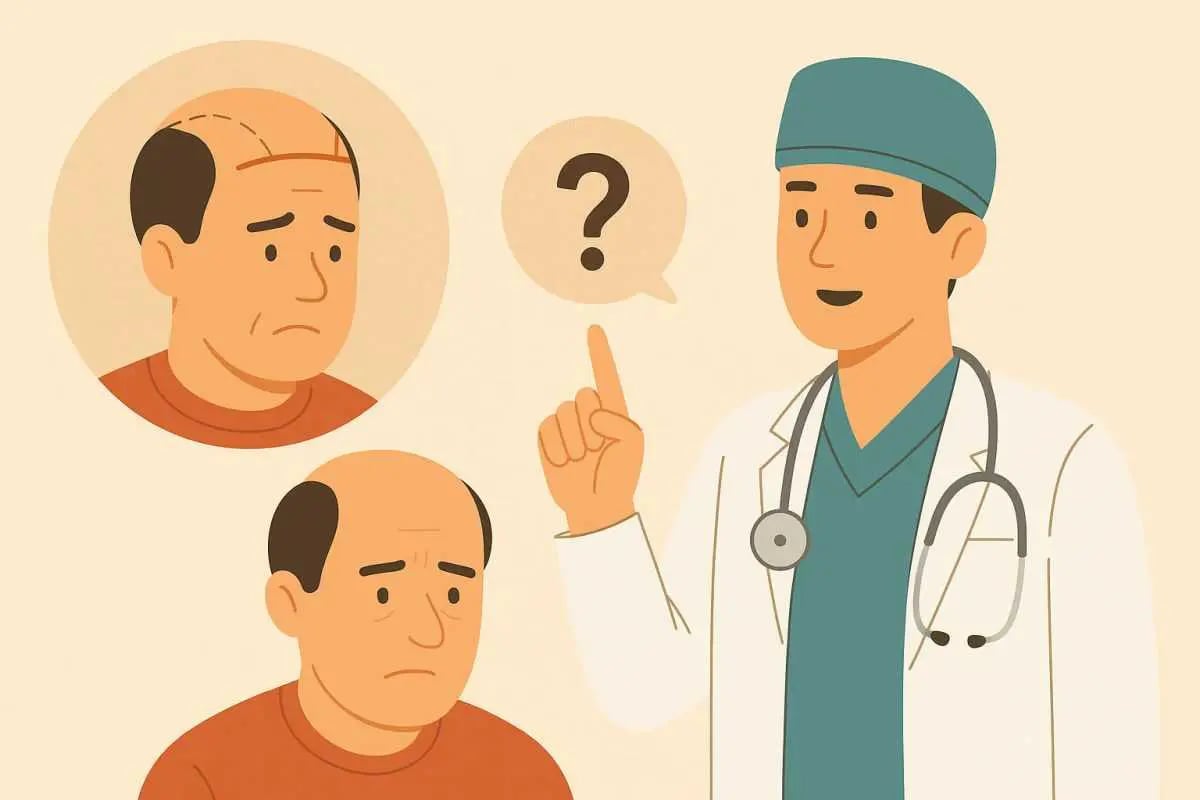
When a man’s hairline keeps receding, the first step is to confirm the cause and the likely future extent of loss — not to decide the graft count first. Male pattern baldness often starts at the temples or forehead, but a mature hairline, a naturally high forehead, traction, inflammation, or scarring alopecia can all look similar.
Key point: A hairline transplant redistributes donor follicles to the forehead — it does not increase the total number of follicles on the head, nor stop the surrounding native hair from continuing to thin. Planning must consider the diagnosis, donor supply, face shape, age, hair flow, and long-term loss management together, so you’re not just patching the current gap. Graft count, FUE/FUT, whether to shave, and recovery time all have no fixed answer — they need a professional doctor’s in-person assessment.
Is a Receding Male Hairline Always Male Pattern Baldness?
Not necessarily. Male pattern baldness often shows symmetric M-shaped temple recession with the forehead hair gradually thinning, later possibly extending to the crown; a mature hairline is usually just a slight upward shift after puberty, with little long-term change.
If there’s sudden short-term thinning, a gap on only one side, or accompanying redness, itching, flaking, pain, pustules, or smooth scarring, you should first rule out telogen effluvium, alopecia areata, traction alopecia, and inflammatory or scarring conditions. These can’t be judged from a photo or forehead proportions alone. The table below lists common situations and the next step:
| Situation | Visual clues | Next step |
|---|---|---|
| Male pattern | Temples/forehead recede over years, uneven hair calibre, may add crown thinning | Assess miniaturisation, family history, long-term treatment |
| Mature hairline | Slight rise after puberty, shape and density stable long-term | Track with fixed-angle photos; don’t judge from one shot |
| Naturally high forehead | Hairline always higher, no ongoing thinning or clear miniaturisation | Reassess after checking proportions, donor supply, expectations |
| Traction/inflammatory | Styling tension, redness, itching, flaking, pain, or scarring together | Stop the trigger, treat disease; active phase usually unsuitable |
| Telogen effluvium | Recent whole-head shedding, often with stress, illness, weight or drug changes | Find the trigger and watch recovery; don’t rush a transplant |
When Is It Suitable to Assess a Hairline Transplant?
Those more suitable for further assessment usually have a clearly defined hairline defect, a confirmed hair-loss diagnosis, adequate donor density and calibre, stable scalp disease, and can accept the limits of donor supply and visual density. Age is not a single threshold, but a young man whose loss is still progressing fast should conservatively reserve future donor supply — drawing the hairline very low while the hair behind keeps thinning can create a “hair in front, gap behind” look.
- Can be assessed further: clear diagnosis, stable donor, reasonable expectations, willing to follow up long-term
- Treat first, then assess: sudden increased shedding, scalp inflammation, or unstable chronic illness/medication
- Usually not advisable to force: diffuse donor thinning, active scarring alopecia, or demanding density/area beyond available follicles
How to Design a Natural Hairline? How Many Grafts?
Hairline design isn’t about applying a fixed number of centimetres, nor redrawing your teenage line. The doctor combines forehead height, facial length and width, brow bone, temporal angles, existing frontal hair, age, and family loss extent to decide the central height and the connection to the sides. A natural look usually comes from many details: an irregular transition zone at the very front, finer or single-hair follicles placed first, then density built up behind; the implant angle and direction must match native hair flow. The lower and wider the hairline, the more donor supply it usually consumes.
On graft count: There’s no directly applicable standard like “a male hairline is usually within 2,000 grafts.” The count varies with how far the line is lowered, temple area, whether the forehead is densified, target density, calibre, curl, and hairs per graft. For the same area, fine straight hair and coarse curly hair give different visual coverage. At consultation, ask the doctor to spell out the expected area, per-zone layout, and the difference between grafts and hairs — don’t just compare totals or per-graft prices. To understand pricing, see our article on graft-count calculation.
FUE, FUT, or COMBO? Do You Have to Shave?
The three differ mainly in how follicles are harvested, not in a fixed ranking of hairline naturalness. FUE punches out grafts one by one, leaving scattered dot scars; FUT removes a scalp strip and separates follicles under a microscope, leaving a linear scar; COMBO combines both for some high-graft or donor-planning cases. A small hairline area doesn’t mean FUE is required, and a large area doesn’t mean FUT — it depends on grafts needed, scalp laxity, donor density, hair length, prior surgery, and scar tolerance, and on confirming who does the harvesting, separation, and implantation.
On shaving: You don’t necessarily have to shave the whole head, but whether the donor and recipient areas are trimmed depends on technique, graft count, existing length, and team workflow. FUE often needs the donor area trimmed short; partial-shave or long-hair FUE may reduce visible change, but operating time, suitable graft count, and cost can differ; FUT usually doesn’t need a large occipital shave. Keeping the recipient area long helps camouflage but can add identification and handling difficulty — don’t make “no shaving” the single reason for choosing a clinic or technique.
How Long Is Recovery? What Are the Limits and Risks?
Times for washing, removing dressings, exercise, and returning to work should follow the surgical team’s individual instructions — you can’t write a blanket “wash on day 2, exercise on day 5.” Early on, scabs, redness, tightness, or brief numbness are common; some transplanted shafts shed within weeks after surgery, which does not mean the follicles have failed. New hair usually emerges gradually months later, and a hairline is often assessed more fully at around 12 months, though individual growth rates vary. If there’s persistent worsening pain, purulent discharge, foul odour, fever, rapidly spreading redness, or heavy bleeding, contact the clinic immediately.
Limits and risks: A transplant is surgery and may carry pain, swelling, bleeding, infection, folliculitis, numbness, scarring, temporary shock loss, uneven growth, undesirable direction, or a need for touch-ups; FUE isn’t scarless either, and over-concentrated harvesting can leave the donor sparse or patchy. Donor follicles have relative regional traits, but you can’t claim they’re completely unaffected by DHT, nor promise they never fall out; native hair after surgery may still progress with male pattern loss. If the doctor assesses a need for topical minoxidil, oral finasteride, or other treatment, first confirm the indications, contraindications, side effects, and follow-up — medication is not mandatory for every transplant patient, and you shouldn’t buy it, stop it, or treat it as a guarantee of surgical results on your own.
Does a receding male hairline always need a transplant? +
No. In early male pattern loss, a doctor may first assess medication and monitoring; for a mature hairline, telogen effluvium, or scalp inflammation, the approach differs. A transplant suits those with a clear diagnosis, a stable donor, and reasonable expectations.
How many grafts does a male hairline transplant need? +
There's no fixed count. How far the line is lowered, temple area, forehead densification, calibre, curl, hairs per graft, and target density all affect the estimate — it can only be planned after measuring the area and donor zone.
FUE or FUT for a hairline transplant? +
Both can rebuild a hairline. FUE harvests graft by graft; FUT removes a strip and separates follicles. Choose by grafts needed, donor density, scalp laxity, hairstyle, prior surgery, and scar tolerance.
Do you have to shave your whole head? +
No. FUE often needs part of the donor area trimmed short, and partial-shave options exist; FUT usually needs no large shave. Whether the recipient area is trimmed depends on existing length, graft count, and team workflow.
When will I see results? +
Some shafts shed within weeks after surgery; new hair usually grows in gradually over months, with calibre and coverage changing; a hairline is often assessed more fully at around 12 months, though growth rates vary.
Will it fall out again after a hairline transplant? +
Transplanted follicles usually keep the donor area's relative traits, but no one can promise they never fall out; surrounding native hair may still thin with male pattern loss. Whether medication or other long-term management is needed should be assessed individually by a doctor against risks and side effects.
Related articles
This article has been reviewed and medically approved by Dr. Wen-Yi Wu

Dr. Wen-Yi Wu|Director, Mong Hair Clinic
- ● Fellow of ISHRS (FISHRS)
- ● ABHRS Board-Certified Hair Restoration Surgeon
- ● President of TSHRS (Taiwan Society of Hair Restoration Surgery)