
Is baldness inherited from dad or uncle?
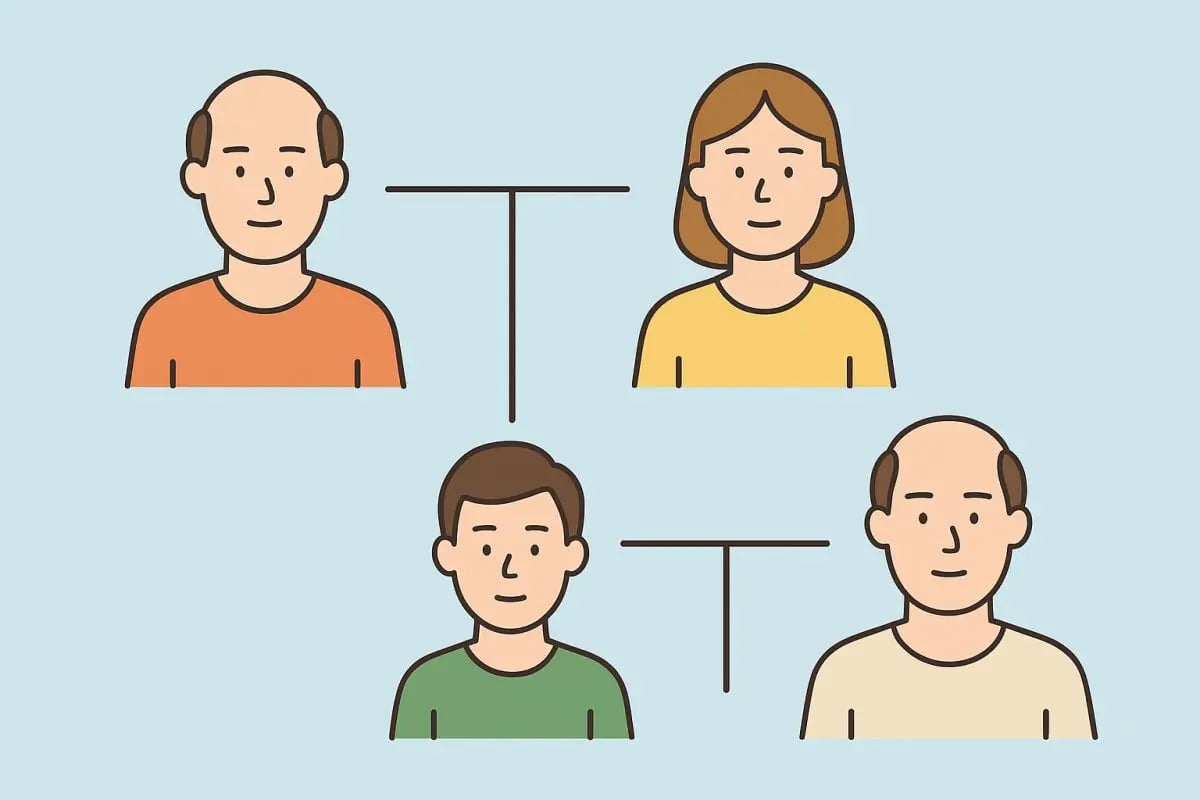
What is Male Pattern Baldness?
Male pattern baldness, also known as hereditary hair loss, is medically known as Androgenetic Alopecia. Common manifestations include:
- Receding hairline, forming a M-shaped forehead or an inverted U-shaped hairline
- Thinning hair volume on the crown, the scalp becomes increasingly visible
- Gradually thinner and shorter hair, with decreased growth ability
- Hair follicles are particularly sensitive to male hormones (DHT)
The key point of male pattern baldness is not simply “shedding hair,” but the gradual atrophy of hair follicles. If treated too late, some hair follicles may enter an irreversible stage.
Dad Doesn’t Go Bald, Does That Mean It’s Safe?
Not necessarily.
Clinically, the following situations are often seen:
- Dad has a normal amount of hair
- An uncle or grandfather has obvious male pattern baldness
- I started experiencing a receding hairline or thinning at the crown between ages 20 to 30
This is because male pattern baldness is influenced by a combination of multiple genes, hormones, lifestyle habits, stress, sleep quality, and other factors. Even if Dad does not have hair loss issues, it does not mean there is no risk of male pattern baldness.
Simple Guide to Male Pattern Baldness Genetic Risk
| Family History | Male Pattern Baldness Risk |
|---|---|
| Father and maternal uncle are both bald | High Risk |
| Maternal uncle is bald, father is not | Moderately High Risk |
| Father is bald, maternal uncle is not | Moderate Risk |
| Neither father nor maternal uncle are bald | Lower Risk, but not zero risk |
Does having the gene mean you will definitely go bald?
Not necessarily.
Possessing genes for male pattern hair loss does not mean you will necessarily suffer from severe hair loss. The true key lies in the sensitivity of hair follicles to DHT, as well as whether the condition is discovered and treated early.
If you notice an M-shaped hairline, thinning at the crown, or thinner hair in the early stages, you can evaluate the condition of your hair follicles through a professional scalp examination. Depending on the situation, consider medication such as Finasteride, Dutasteride, or Minoxidil to delay follicular regression.
Is Baldness Always Genetic? +
It is not necessarily so. Androgenetic alopecia is highly correlated with genetics, but stress, staying up late, hormonal changes, diseases, or medications can also accelerate hair loss. Even if there is a family history, this does not mean you will definitely suffer from severe baldness.
Why is it said that you should check your maternal uncle for hair loss? +
Because certain androgenetic alopecia-related genes are located on the X chromosome. Since a male's X chromosome comes from his mother, whether the maternal uncle has androgenetic alopecia is an important reference point. However, the family history on the father's side also needs to be evaluated.
If my father is not bald, will I definitely not be bald? +
Not necessarily. If the maternal family has clear androgenetic alopecia—for example, for the maternal uncle or grandfather—even if the father's hair volume is normal, there is still a chance that the individual may experience premature hair loss.
At what age should I start paying special attention to hair loss? +
If hairline recession, a receding hairline (M-shaped forehead), thinning at the crown, or hair becoming fine appears between the ages of 20 and 30, it is recommended to undergo early scalp and hair follicle checks to evaluate whether it belongs to early androgenetic alopecia.
Can androgenetic alopecia be prevented? +
Androgenetic alopecia cannot be completely prevented, but through early detection, appropriate treatment, improving sleep quality, and reducing stress, the progression of hair loss can be delayed, and premature atrophy of hair follicles can be avoided.
Related articles
This article has been reviewed and medically approved by Dr. Wen-Yi Wu

Dr. Wen-Yi Wu|Director, Mong Hair Clinic
- ● Fellow of ISHRS (FISHRS)
- ● ABHRS Board-Certified Hair Restoration Surgeon
- ● President of TSHRS (Taiwan Society of Hair Restoration Surgery)