
Can You Have a Hair Transplant With Atopic Dermatitis? Scalp Eczema, Stability and Evaluation
Having atopic dermatitis is not an absolute barrier to a hair transplant. As long as the donor area at the back of the head and the recipient area are not in an acute flare—with redness, weeping, or scratched scabs—and the hair loss comes from stable pattern hair loss, most people can still be evaluated for surgery. In my clinic I often meet patients who have had allergies or eczema since childhood and ask as soon as they sit down: “Dr. Wu, my skin is quite sensitive and my scalp gets dry and itchy when the seasons change—can I still have a hair transplant?” Having an atopic constitution is not a yes-or-no rule on its own; what matters is whether the scalp barrier is stable right now and what is actually causing the thinning.
Key points: Whether someone with atopic dermatitis can have a hair transplant depends on whether the scalp barrier is in a stable phase and whether the thinning is due to pattern hair loss. If the scalp is red, itchy, weeping, or scratched open, a dermatologist should settle the inflammation first; once both donor and recipient skin are calm, a doctor can assess donor supply and surgical planning in person.
Why can atopic dermatitis make hair look thinner?
Atopic dermatitis is a chronic, relapsing inflammatory skin condition marked by a weaker skin barrier, moisture loss, and prominent itch. When dryness and inflammation affect the scalp or hairline edge, people often scratch repeatedly in their sleep or while concentrating at work. That repeated friction damages and snaps hair shafts and keeps the skin around the follicles chronically irritated, making local hair density look thinner.
Beyond breakage and temporary shedding from scratching, some people with an atopic constitution may also develop alopecia areata, because the two conditions share overlapping immune and skin-barrier pathways. At the same time, many adults have scalp eczema that is already fairly settled, yet also experience androgenetic alopecia (pattern hair loss) driven by genetics and hormones—causing a receding M-shaped hairline or a gradually widening crown part.
Different causes of thinning require completely different steps; only stable pattern hair loss or non-inflammatory fixed areas of hair loss are targets for follicle transplantation. If you want to check whether your thinning matches pattern hair loss, see What Is Male Pattern Hair Loss? Causes, Stages and Treatment.
| Observed hair loss pattern | Common likely cause | Scalp appearance and features | Hair transplant evaluation direction |
|---|---|---|---|
| Hairs of uneven length that break easily in itchy areas | Acute eczema flare and repeated scratching | Dry fine flakes, redness, scratch marks, blood crusts or weeping | Postpone surgery; control inflammation and itch with a dermatologist first |
| Sudden, well-defined round or patchy bald spots | Coexisting alopecia areata (autoimmune hair loss) | Smooth skin in the patch, sometimes with exclamation-mark hairs at the edge | Do not transplant immediately; treat first and observe long-term stability |
| Gradual M-shaped recession or thinning at the crown/parting | Coexisting male or female pattern hair loss | Follicles gradually miniaturise in set areas; scalp is not necessarily red | Once scalp eczema is stable, assess the donor area and transplant plan |
How do atopic dermatitis, seborrhoeic dermatitis and scalp psoriasis differ?
Many patients walk into the clinic calling every kind of red, flaky, itchy scalp “scalp eczema”. In clinical evaluation, however, atopic dermatitis, seborrhoeic dermatitis, and scalp psoriasis differ in scale texture, typical locations, and pre-operative precautions. Clarifying which condition is present helps determine when surgery can safely be scheduled.
An atopic scalp usually feels dry, tight, and intensely itchy, and patients often have dry itchy rashes in the elbow creases or behind the knees, or a personal or family history of allergic rhinitis or asthma. Seborrhoeic dermatitis favours oil-rich areas and produces yellowish, greasy flakes, whereas psoriasis typically forms sharply defined red plaques with thicker silvery-white scale and requires care regarding wound-triggered plaques.
If you are also concerned about oily flakes or silvery plaques before surgery, see Can You Have a Hair Transplant With Seborrhoeic Dermatitis? and Can You Have a Hair Transplant With Scalp Psoriasis?.
| Feature | Atopic dermatitis (scalp eczema) | Seborrhoeic dermatitis | Scalp psoriasis |
|---|---|---|---|
| Typical scalp and scale signs | Dry skin, fine white flakes, intense itch, often with scratch marks or crusts | Oily, reddish scalp with yellowish greasy flakes | Well-defined red plaques covered by thicker silvery-white scale |
| Common accompanying clues | Dry rashes on the neck or limb creases, or history of allergic rhinitis or asthma | Redness and flaking between the brows, beside the nose, or behind the ears | Plaques along the hairline edge, behind the ears, on elbows/knees, or nail changes |
| Key pre-transplant focus | Confirm an intact skin barrier without weeping or broken skin, and prevent post-op scratching | Control excess oil and inflammation first to reduce post-op folliculitis risk | Assess only when plaques are inactive and watch for wound-triggered flares |
Why do I advise postponing a hair transplant during an acute flare?
Although a hair transplant is a minimally invasive, superficial procedure, both extracting follicles from the back of the head and creating tiny recipient sites at the front or crown rely on a healthy skin barrier and stable microcirculation for healing. Operating while the scalp is in an acute atopic dermatitis flare—when the outer skin barrier is disrupted and local inflammatory signals are active—brings three practical risks.
First, scratched or weeping skin easily harbours bacteria such as Staphylococcus aureus; making hundreds of tiny incisions in inflamed, broken skin raises the chance of wound infection or secondary folliculitis. Second, an acutely inflamed recipient area has more tissue oedema and exudate, which can interfere with how newly implanted follicles establish their blood supply.
Third—and very common in daily practice—the itch of an active eczema flare is extremely hard to resist. Newly implanted grafts are not yet anchored firmly during the first two weeks; rubbing or scratching the recipient area half-asleep can physically dislodge the grafts. If you also want to learn about scalp pustules and infection warning signs, see Can Scalp Folliculitis Cause Hair Loss?.
What 4 key areas do I check during a hair transplant consultation?

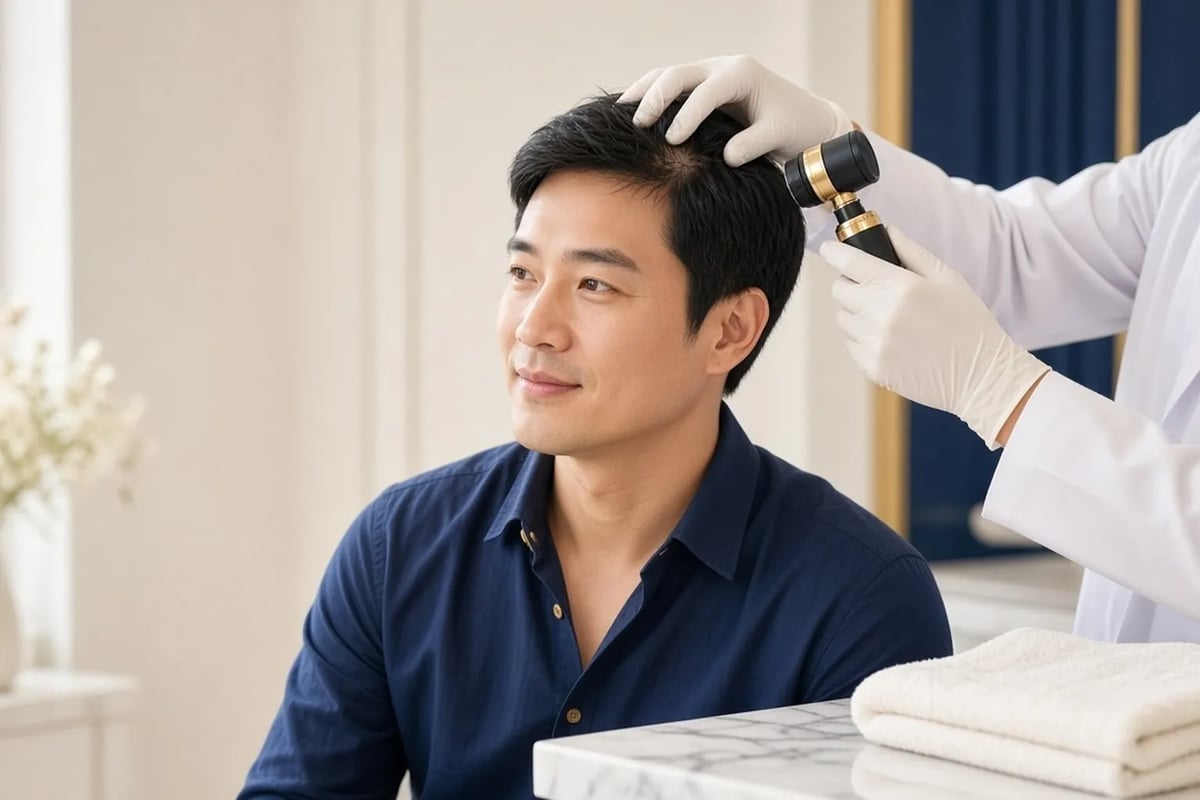
When a patient with a history of atopic dermatitis comes for a consultation, I look beyond how much hair is missing at the hairline and evaluate four areas together: scalp stability, hair loss pattern, donor area condition, and long-term care readiness. High-magnification dermoscopy helps distinguish subtle background inflammation from true follicle miniaturisation.
First, I inspect the skin barrier in both the recipient area and the back-of-head donor zone to confirm there are no active red plaques, weeping, scratched blood crusts, or thickened lichenified skin; some patients look clear on top of the head but have recurrent eczema near the nape from sweat and collar friction, which affects where donor grafts can be taken. Second, I confirm whether the hair loss is stable pattern hair loss rather than temporary shedding after a severe eczema flare or poor sleep.
Third, I measure follicle density, hair shaft calibre, and scalp laxity in the safe donor zone to calculate how many grafts can be harvested safely. Fourth, we discuss realistic visual density expectations and post-operative care. For a full overview of pre-surgical checks, see What to Assess Before a Hair Transplant?.
FUE vs FUT: how should someone with atopic dermatitis choose?
Once the scalp is calm and free of active eczema, patients with atopic dermatitis are not restricted to a single technique. Choosing between FUE (follicular unit excision) and FUT (strip harvesting) depends on the required graft count, the skin condition at the back of the head, and how you wear your hair.
For most patients with sensitive or atopic skin who need a moderate number of grafts, FUE is often considered first in clinic. Because FUE extracts follicles through tiny scattered micropunches, the wounds are small dots that heal quickly without a linear suture line or the tight pulling sensation during stitch removal—making post-operative care easier on skin that is prone to itching when stretched or irritated by sutures.
If hair loss covers a larger area requiring more grafts, and the skin at the back of the head is supple without a history of thick scars or chronic lichenified eczema near the neck, FUT or a combined COMBO plan can still be discussed. However, if the lower occipital skin has become thickened and tight from years of scratching, excising a wide strip is best avoided so suture tension does not add to post-operative discomfort. To compare harvesting methods in detail, see How to Choose a Hair Transplant Method? FUT, FUE and COMBO Compared.
Should I stop my dermatology ointments or medications before a transplant?
Patients often ask me in clinic: “Dr. Wu, to prepare for a hair transplant, should I stop all the topical ointments, oral anti-itch tablets, or immunomodulatory treatments my dermatologist prescribed?” My principle is clear: please do not stop your prescribed atopic dermatitis treatments on your own, as stopping abruptly can trigger a sharp rebound flare right around the time of surgery.
At your initial assessment, please bring a list of all treatments you currently use—including topical corticosteroids or non-steroidal calcineurin inhibitors, oral antihistamines, or systemic medications and biologics for moderate-to-severe atopic dermatitis. I coordinate with your prescribing dermatologist around your planned surgery date and wound-healing needs so your perioperative medication plan stays safe and steady.
Also pay attention to topical hair growth products: if your scalp still has tiny cracks or dry irritation, avoid buying and applying over-the-counter hair growth solutions on your own, as solvents in some liquids can sting a compromised barrier and trigger contact dermatitis. When to pause or resume topical products before and after surgery should be guided individually by your surgeon.
How should sensitive or eczema-prone scalps be cared for before and after surgery?

For patients with an atopic constitution, the core goal of daily scalp cleansing before and after a transplant is keeping the skin barrier calm and breaking the itch–scratch cycle. In daily life and before surgery, wash with lukewarm-to-cool water rather than hot water, and choose a mild cleanser free of heavy fragrance or harsh surfactants.
The first two weeks after surgery are critical as transplanted follicles anchor in place. During this window, mild itching is common as tiny wounds heal, nerve endings recover, and thin scabs dry. Follow the clinic’s washing instructions carefully: lather a gentle shampoo in your palms first, press the foam lightly onto the recipient area with your fingertips, rinse with a gentle stream of water, pat dry with a clean towel, and use cool air from a hairdryer—never pick or scratch scabs with your fingernails.
Keep your bedroom cool and ventilated during early recovery to avoid heavy sweating, late nights, or known allergen triggers. If noticeable dryness or itching develops after surgery, come back for a review so your doctor can arrange suitable soothing care rather than applying strong household steroid ointments directly onto newly implanted grafts. For step-by-step post-op care, see How to Care for Hair After a Hair Transplant.
When should surgery be postponed, and what can you prepare before your visit?

To protect surgical safety and graft healing, I honestly advise postponing surgery and prioritising dermatology care if examination shows any of the following: active redness or weeping in the donor or recipient area, honey-coloured crusts suggesting bacterial infection, recent acute diffuse shedding, or uncontrolled night-time scratching.
Once dermatology care has kept your scalp free of red rashes and broken skin for a sustained period and your hair loss pattern is stable, it is a good time to come in for a hair transplant evaluation. Before your appointment, preparing three simple items helps a lot: a brief note of how often and where your scalp has flared over the past six months, a list of your current oral and topical dermatology medications, and photos of your hairline or parting from different periods.
| Evaluation item | Stable state suitable for transplant evaluation | State where dermatology treatment should come first |
|---|---|---|
| Recipient and donor skin condition | Intact skin without weeping or broken marks; at most mild dryness managed with gentle daily care | Obvious red plaques, blisters, weeping exudate, fresh scratch marks, blood crusts or yellow pustular crusts |
| Itch control and night-time habits | Daily itch is calm and you do not scratch your scalp forcefully in your sleep | Severe day-and-night itching that leads to bleeding scratch marks or disturbed sleep |
| Hair loss type and course | Confirmed stable pattern hair loss or fixed hairless area with sufficient occipital donor density | Recent acute heavy shedding, or active alopecia areata or infectious hair loss |
| Medication and aftercare readiness | Able to share a clear list of current dermatology medications and follow gentle fingertip washing and reviews | Stopping medication on your own causing rebound flares, or applying unverified remedies during acute flares |
A note from the doctor
In clinic I often meet patients with atopic dermatitis or sensitive scalps who worry that their skin condition rules out a hair transplant forever. Having a chronic allergic constitution does not take away your chance to improve a receding hairline or thinning crown; what truly affects surgical safety and graft stability is whether the scalp is acutely red, itchy, broken, or scratched on the day of surgery.
If you are dealing with both an itchy scalp and thinning hair, there is no need to abruptly stop your dermatology ointments or keep switching shampoos on your own. Let a dermatologist settle the inflammation and itch–scratch cycle first, and then we can use a dermatoscope together to check your hair loss pattern, donor supply at the back of the head, and the right timing for surgery. Taking it step by step gives a much steadier result.
This article is general medical information and does not replace an individual diagnosis.
Medical references
- American Academy of Dermatology (AAD): Eczema types: Atopic dermatitis overview
- American Academy of Dermatology (AAD): Eczema types: Atopic dermatitis symptoms
- National Health Service (NHS): Atopic eczema (atopic dermatitis)
- Frontiers in Immunology (PMC12440913): Overlapping features of atopic dermatitis and alopecia areata: from pathogenesis to treatment
- StatPearls (NCBI Bookshelf NBK547740): Hair Transplantation
- International Society of Hair Restoration Surgery (ISHRS): Make an Informed Decision in Choosing a Qualified Hair Surgeon
Do transplanted follicles have a lower survival rate in patients with atopic dermatitis? +
As long as surgery is performed when the scalp barrier is stable without acute redness or weeping, and the recipient area is protected from scratching and infection afterwards, an atopic constitution itself does not stop transplanted follicles from growing.
How long does the scalp need to be stable before scheduling a hair transplant evaluation? +
There is no single fixed number of days for everyone. The core requirement is that both the back-of-head donor area and the recipient area have intact skin with no broken scratch marks or active red plaques, and night-time itching is well controlled.
If I only have eczema on my elbows or knees and never on my scalp, can I get a hair transplant? +
Yes, you can be evaluated. Many adults have atopic dermatitis only on flexural skin while their scalp remains healthy. Once dermoscopy confirms stable donor and recipient skin, planning follows the standard pattern hair loss workflow with gentle post-op cleansing.
Will the local anaesthetic or antiseptic used during a hair transplant trigger an allergic flare? +
Atopic dermatitis involves skin barrier function and immune regulation, which is different from a true allergy to local anaesthetics. However, sensitive skin can react to harsh cleansers or dressings, so please share any history of reactions to ointments, antiseptics, tapes or antibiotics beforehand.
If my scalp feels itchy during recovery after a transplant, can I apply my usual eczema ointment? +
Please do not apply topical ointments directly to newly implanted grafts on your own. Mild itching in the first two weeks is often part of normal healing and scabbing. If noticeable redness or severe itch develops, return for a review so your surgeon can prescribe appropriate care.
Can people with atopic dermatitis use topical hair growth solutions or oral hair loss medication? +
This should be assessed by a doctor. Some topical solutions contain propylene glycol or alcohol, which can sting or trigger contact dermatitis if applied to a dry, cracked scalp barrier. Oral medication depends on your specific hair loss diagnosis and overall health.
Related articles
Written by:Taiwan Hair Clinic Editorial Team
This article has been reviewed and medically approved by Dr. Wen-Yi Wu

Dr. Wen-Yi Wu|Director, Mong Hair Clinic
- ● Fellow of ISHRS (FISHRS)
- ● ABHRS Board-Certified Hair Restoration Surgeon
- ● President of TSHRS (Taiwan Society of Hair Restoration Surgery)