
Why Does a Crown Hair Transplant Need More Grafts? Whorl, Area and Density Planning
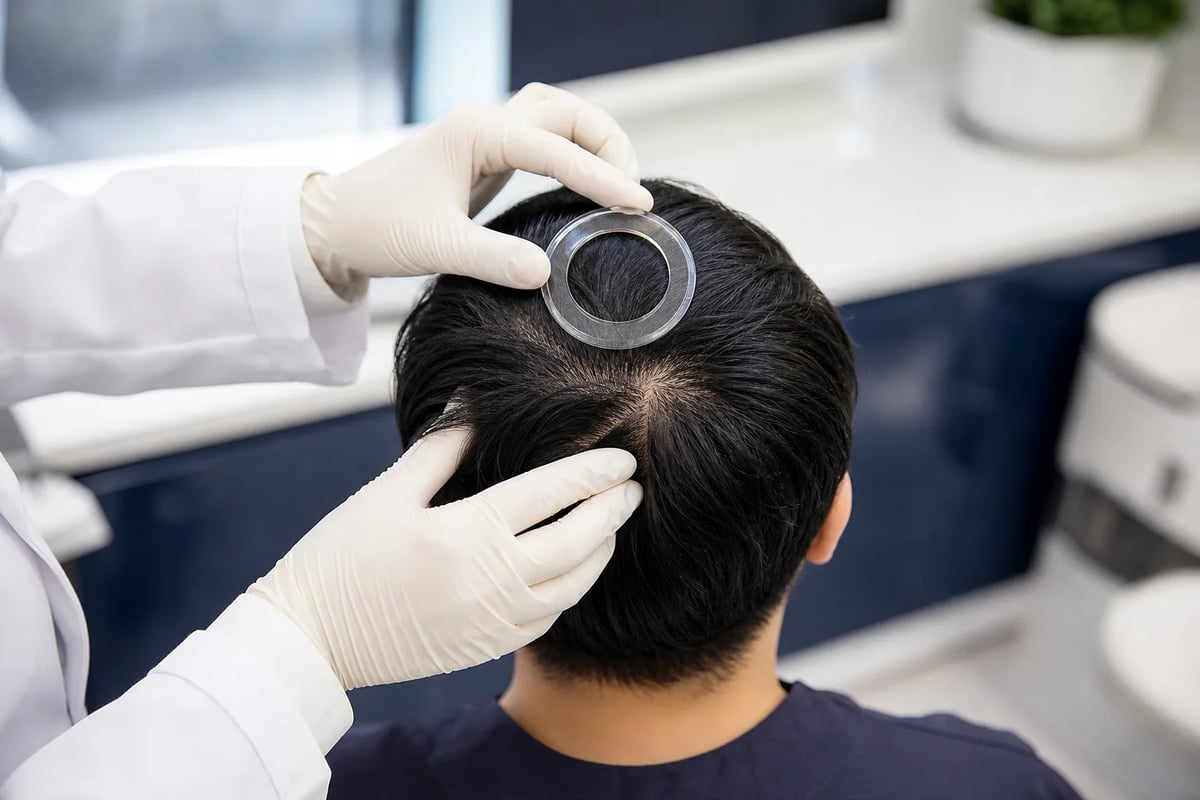
Crown hair transplantation often consumes more grafts than patients expect. A whorl radiates from its centre in several directions, so the hairs cannot overlap as uniformly as they do at the frontal scalp. Adding only a small outer ring can also enlarge the total treatment area substantially.
This does not mean that every crown should receive the highest possible density, nor is there one graft number that suits everyone. The plan must consider the actual area, ongoing miniaturisation, whorl direction, hair calibre, hairs per follicular unit and the donor supply that must last for life.
Key point: the crown is sometimes called a “graft black hole” not because follicles survive poorly there, but because area, radial hair flow and limited donor supply all affect visible coverage. Establishing whether hair loss is stable and deciding the priority of the front, mid-scalp and crown matter more than a single graft number.
Why does the crown often need more grafts than the frontal scalp?
Frontal hair usually points backwards or diagonally, allowing length and overlap to conceal the scalp. Crown hair rotates away from a centre and can be viewed directly from above. The same number of grafts per square centimetre can therefore create a different visual result in the two areas.
Crown loss may not have a neat circular border. If the surrounding native hair is still miniaturising, the area drawn today may expand over the next few years. Planning should include a transition zone instead of filling only the emptiest centre.

Our complete hair transplant guide explains how follicles are moved from the donor area to regions that need coverage. The same principle applies in the crown: follicles are redistributed, not created.
| Planning factor | Frontal hairline | Crown and whorl |
|---|---|---|
| Main direction | Usually backwards or diagonally | Rotates and radiates from a centre |
| Visual coverage | Length can overlap in layers | The centre and changing directions expose more scalp |
| Future change | A hairline position can be defined | The outer native hair may continue to miniaturise |
| Design priority | Natural hairline and facial proportion | Centre, rotation, area and donor priority |
Can crown graft numbers be calculated by area multiplied by density?
Area multiplied by a planned density is useful as an initial estimate, but it is not a surgical promise. Coarse or wavy hair and follicular units containing more hairs can provide greater visual coverage. Fine, straight hair or a strong contrast between hair and skin makes the scalp more visible.
Existing hair also changes the plan. When many miniaturised follicles remain, recipient sites must be placed carefully and the doctor must decide whether hair loss should first be stabilised. A completely bald centre requires a different distribution.

Read how hair transplant graft numbers are estimated for the limits of common formulas. A formula is a starting point; final planning requires direct examination.
| Factor | Why it matters |
|---|---|
| Measured area | A modest increase in the radius of a circular area produces a much larger total area |
| Hair calibre and contrast | Coarser hair or lower hair-to-skin contrast usually provides better visual coverage |
| Hairs per follicular unit | Single-hair and multi-hair grafts create different visual volume |
| Whorl centre and direction | Angles must follow the natural flow, not only a density target |
| Native hair and progression | Determine the transition zone and the grafts reserved for the future |
| Donor density | Safe lifetime supply has an upper limit |
How do whorl angles affect naturalness and coverage?
A natural whorl is not a bundle of upright hairs. It lies at relatively low angles and extends outward according to each person’s clockwise or anticlockwise pattern. Recipient-site creation should identify the native centre, rotation and changes of direction.
When directions and angles are discontinuous, even a high graft count may produce crossing hairs, difficult styling or uneven show-through. Following the natural flow helps neighbouring hairs overlap, but it cannot turn a finite graft supply into native density.
Two whorls or an unusually placed centre require more complex design. See our double-whorl hair transplant assessment.
Why must the front, mid-scalp and crown share a donor priority plan?
The number of transplantable follicles at the back and sides is finite, while androgenetic alopecia may affect the front, mid-scalp and crown together. If too many grafts are concentrated in the crown, future frontal or mid-scalp recession may be difficult to connect naturally.
Planning considers which area has the greatest visual impact, which native hair may still respond to treatment and what hairstyle and density the patient can accept. For extensive loss, establishing the frontal frame and mid-scalp connection before defining crown coverage may be more practical than dividing grafts equally. How many hair transplants can a person have? explains why every procedure draws from the same limited resource.
What is the halo effect after crown transplantation?
The “halo effect” occurs when transplanted hair remains in the centre but native hair around it keeps miniaturising, creating an isolated island surrounded by thinning hair. It is related to stability, treatment area and long-term follow-up—not to one universal age threshold.
Age 35 may be a useful reference when observing the pattern in some patients, but it is not a rule for everyone. Medication is also not mandatory for every patient. Diagnosis, health, preferences and potential risks determine whether treatment is appropriate. Patients with active miniaturisation can read Do You Need Medication After a Hair Transplant? Native Hair, Stopping and Assessment and discuss options with a doctor rather than starting or stopping medication themselves.
Who may be suitable for crown hair transplantation?
A photograph alone is not enough. The doctor first confirms the cause of hair loss and excludes alopecia areata, scarring alopecia, inflammation and other scalp disease that may affect surgery. The rate of progression and degree of miniaturisation then guide timing.
When the pattern is relatively stable, donor conditions are sufficient and the patient understands that the goal is visual improvement rather than restoration of original density, graft range and coverage can be discussed. When loss is changing rapidly, monitoring or treatment is often more sensible than immediately filling the centre. Prepare for consultation with our hair transplant assessment guide.
How are crown area and graft numbers measured in consultation?
The crown is examined under different angles and lighting. The doctor identifies the whorl centre and direction, measures the intended area and uses magnification to compare density, calibre and follicular-unit composition in the recipient and donor zones. Where native hair remains, variation in shaft thickness and miniaturisation are also assessed.
Only then are the patient’s priorities, acceptable hairstyle, desired visual coverage and grafts reserved for the future combined into one plan. The final number is an individual range and should not be decided from online photographs or a single formula.
Dr Wu’s video: crown thinning and the halo effect
This original video by Dr Wu discusses stability, medical assessment and donor conditions before crown surgery. The article adds detail about whorl angles, area and graft allocation.
Dr Wen-Yi Wu: the crown is a long-term hair plan, not a circle to fill
Crown transplantation must combine whorl direction, measured area, stability of native hair and available donor follicles. More grafts are not automatically better. Reserving resources for the front, mid-scalp and future progression helps the overall flow and density remain coherent over time.
This article provides general medical information and cannot replace an individual diagnosis, prescription or surgical plan. Rapidly expanding loss, patchy baldness, redness, pain, scaling or scarring should be assessed by a dermatologist or hair specialist first.
References
How many grafts does a crown hair transplant usually need? +
There is no fixed number. The estimate depends on the measured area, hair calibre, hairs per follicular unit, whorl direction, remaining native hair and donor density. Two patients with a similar-sized area may need very different graft numbers.
Is higher density always better in the crown? +
No. Density must be balanced against scalp condition, existing hair, natural flow and the finite donor supply. Maximising one area can reduce the grafts available for the frontal or mid-scalp areas and future procedures.
Can a transplanted crown look unnatural? +
It can if the centre, direction and incision angles do not follow the native whorl. Identifying the natural pattern before surgery and reproducing its low-angle flow are central to a natural-looking design.
Are younger patients unable to have crown transplantation? +
Age alone does not decide suitability. A younger patient with rapidly progressing loss usually needs more conservative planning. Stability, family history, response to treatment and donor capacity all matter.
Must I take finasteride before crown transplantation? +
Not everyone needs or can use the same medication. When androgenetic alopecia is active and surrounding hairs are miniaturising, a doctor will usually discuss treatment options. The choice and risks require an individual medical assessment.
What is the halo effect after crown transplantation? +
It describes transplanted hair remaining in the centre while surrounding native hair continues to thin, leaving a dense island with a sparse ring. Assessing progression, planning a transition zone and long-term follow-up can reduce this risk.
Related articles
This article has been reviewed and medically approved by Dr. Wen-Yi Wu

Dr. Wen-Yi Wu|Director, Mong Hair Clinic
- ● Fellow of ISHRS (FISHRS)
- ● ABHRS Board-Certified Hair Restoration Surgeon
- ● President of TSHRS (Taiwan Society of Hair Restoration Surgery)