

Can Thyroid Problems Cause Hair Loss? Hypothyroid vs Hyperthyroid Shedding, Tests and When to See a Doctor
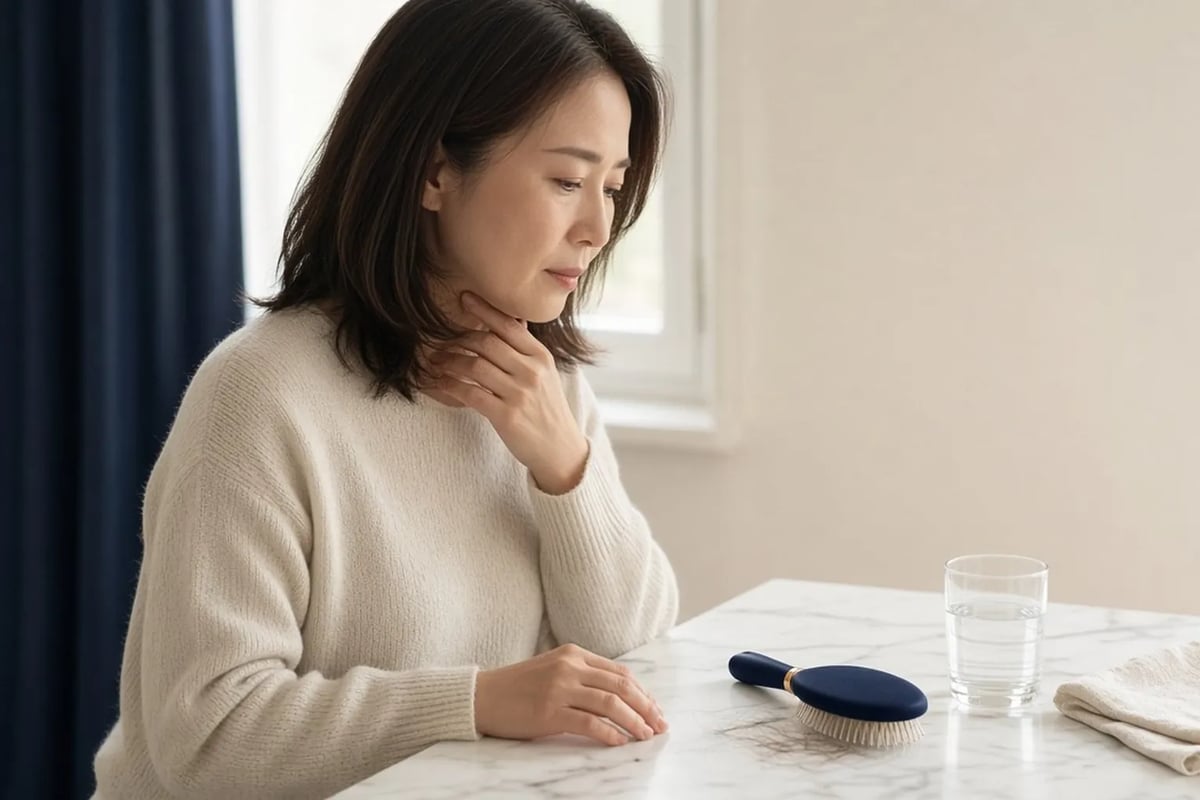
Can thyroid problems cause hair loss? Yes. An underactive thyroid (hypothyroidism) and an overactive thyroid (hyperthyroidism) can both disrupt the hair growth cycle, leaving hair finer and thinner across the whole scalp. For most people, hair has a chance to slowly grow back once the thyroid is well controlled, but it takes time.
A woman in her forties once sat down in my clinic and said, “Doctor, I’m losing so much hair when I wash it, and my ponytail keeps getting thinner. Am I going bald?” When I asked more, she told me she had felt tired and cold for the past six months, and her weight had been creeping up. I sent her for a blood test, and it showed hypothyroidism. Cases like this, where the hair raises the alarm first, are not unusual in clinic.
Key points: both hypothyroidism and hyperthyroidism can cause diffuse hair loss. It usually shows as thinning all over with finer strands rather than patchy bald spots, and it usually does not lead to complete baldness. When a thyroid problem is suspected, the usual first step is a blood test for TSH and free T4, while also ruling out other causes such as iron deficiency. After thyroid treatment stabilises, hair usually takes several months to recover; do not stop or adjust your medication on your own in the meantime. Thyroid-related hair loss generally does not call for a transplant. If pattern hair loss is also present, wait until the thyroid is stable and the pattern of loss is clear, then let a doctor assess whether a transplant is suitable.
Why does the thyroid affect hair?
The thyroid sits at the front of the neck. The hormones it makes act like the body’s “metabolic accelerator”, affecting heart rate, body temperature and skin, and also the growth rhythm of hair follicles. Hair cycles through growth (anagen), regression (catagen) and resting (telogen) phases. Too little or too much thyroid hormone can push more follicles into the resting phase early, and a few months later those hairs shed together.
A 2023 review of thyroid disease and hair disorders found that hyperthyroidism, hypothyroidism and hypothyroidism caused by treatment can all trigger diffuse shedding across the scalp, and that hair loss sometimes appears before other symptoms. That is why some people first notice their hair thinning and only then trace it back to the thyroid.
Thyroid-related hair loss is mostly non-scarring, meaning the follicles themselves are still there. The American Thyroid Association’s patient booklet also notes that in hypothyroidism hair can become dry, coarse and brittle; the amount of hair loss varies, and hair can look thinner but usually does not go bald.
How does hair loss differ between an underactive and an overactive thyroid?
Both can make hair thinner overall, but the hair texture and how your body feels tend to differ. With hypothyroidism the body seems to “slow down”: hair tends to be dry, coarse and brittle, and some people also lose the outer third of their eyebrows. With hyperthyroidism the body seems to “speed up”: hair often becomes fine, soft and sheds easily.
The American Thyroid Association lists hair loss among the common symptoms of hyperthyroidism, along with heat intolerance, sweating, palpitations, tremor, weight loss and poor sleep. As for which one causes more noticeable shedding, research is mixed: a 2024 study of 500 women with telogen effluvium found that shedding was more severe in the hypothyroid group, while the hyperthyroid group did not differ clearly from those with normal thyroid function.
The table below summarises the usual differences, but blood results and a doctor’s assessment come first.
| Feature | Underactive thyroid (hypothyroidism) | Overactive thyroid (hyperthyroidism) |
|---|---|---|
| Hair changes | Thinning all over; hair dry, coarse and brittle | Thinning all over; hair finer, softer and sheds easily |
| Other body hair | Some people lose the outer third of the eyebrows | Specific areas are less often affected |
| Common body symptoms | Tiredness, feeling cold, dry skin, constipation, weight gain, slowed thinking | Heat intolerance, sweating, palpitations, tremor, weight loss, poor sleep, feeling on edge |
| Common causes | Autoimmune thyroiditis; after thyroid surgery or treatment | Autoimmune hyperthyroidism; overactive thyroid nodules |
| Pattern of loss | Diffuse, non-scarring; usually no baldness | Diffuse, non-scarring; usually no baldness |
How do you tell thyroid hair loss from pattern hair loss and other types?

The most typical thyroid-related hair loss is “even thinning all over”: more hair comes out when you wash or brush it and your ponytail gets thinner, but the loss is not concentrated at the hairline or crown. Pattern hair loss develops gradually; in men it usually starts with a receding hairline or thinning crown, while in women a gradually widening parting is common.
The tricky part is that the two often coexist. When a thyroid problem thins the hair overall, pattern hair loss that was barely noticeable can suddenly become obvious; and once the thyroid is treated, the pattern hair loss does not go away with it. If you are also wondering whether you have pattern hair loss, see What Is Male Pattern Hair Loss? Causes, Stages and Treatment.
Autoimmune thyroid disease is also linked to alopecia areata. A 2023 literature review of the skin manifestations of thyroid disease notes that people with autoimmune thyroid disease have a higher risk of other autoimmune conditions, alopecia areata among them, which is why patients with alopecia areata are often advised to have their thyroid checked. If you are also worried about sudden round, patchy bald spots, see a doctor early rather than applying harsh home remedies.
If you cannot tell which type you have, or suspect more than one cause, write down what you have noticed and bring it to your appointment.
| Type of hair loss | Typical signs | Link with the thyroid | How it is assessed |
|---|---|---|---|
| Thyroid-related telogen effluvium | Even thinning all over; shed hairs have a white bulb at the root; often with other thyroid symptoms | Can be triggered directly by hypothyroidism or hyperthyroidism | Thyroid blood tests and treatment of the underlying condition |
| Male or female pattern hair loss | Receding hairline, thinning crown or widening parting; strands gradually become finer | Not caused by the thyroid, but thyroid problems can make thinning more obvious | Dermatoscope check of follicle miniaturisation; discuss treatment or monitoring |
| Alopecia areata | Well-defined round or patchy bald areas | Often occurs alongside autoimmune thyroid disease | Dermatology treatment plus a thyroid check |
| Iron deficiency or poor nutrition | Thinning all over, possibly with tiredness and pale skin | Symptoms overlap with thyroid problems, so both are often checked | Blood tests such as haemoglobin and ferritin |
When should you suspect your thyroid, and which blood tests are needed?

Thyroid-related hair loss rarely appears on its own. If your hair loss comes with any of the following, I recommend a blood test for thyroid function:
- Thinning all over or a clear change in hair texture lasting more than three months
- Often feeling tired or cold, dry skin, constipation, or unexplained weight gain
- Heat intolerance, sweating, palpitations, tremor, poor sleep, or unexplained weight loss
- A swollen front of the neck, a lump-in-the-throat feeling when swallowing, or bulging or puffy eyes
- A family history of thyroid disease, or another autoimmune condition yourself
- Any of these symptoms in the months after giving birth
The American Thyroid Association explains that TSH is the most commonly used test of thyroid function, usually paired with free T4. If needed, a doctor may add T3 or thyroid antibodies to see whether the cause is autoimmune. Because hair loss often has more than one cause, the doctor may also check haemoglobin and ferritin to rule out iron deficiency or anaemia.
Hair loss in the months after giving birth is most often postpartum telogen effluvium, but postpartum thyroiditis can occur at the same time. If postpartum shedding is not improving, or comes with palpitations or marked tiredness, see a doctor for a check-up.
What should you know before the blood test?
Many people who are losing hair buy supplements marketed for healthy hair, and these often contain high-dose biotin (vitamin B7). Patient information from the American Thyroid Association warns that biotin does not change your actual thyroid function, but it can interfere with some laboratory methods, making TSH and T4 results inaccurate and even mimicking hyperthyroidism. Singapore’s Health Sciences Authority has issued the same warning.
So before a blood test, tell your doctor about every supplement and medicine you take, and follow the instructions from your doctor or the laboratory about pausing biotin-containing products for a few days. If you already take thyroid medication, also ask whether to take it before the test on the day.
After thyroid treatment, how long does hair take to grow back?
This is the question I am asked most. The hair cycle is long: it takes time for follicles to re-enter the growth phase and for new hair to show visible length and density. So after thyroid levels stabilise, hair usually needs several more months to improve gradually. Shedding does not stop the moment you have a blood test or start medication.
Some people feel they shed even more when they first start treatment for hypothyroidism. A literature review suggests this may be follicles that were stuck in the resting phase restarting growth and pushing old hairs out, and it is usually temporary. However, another review cautions that when hypothyroidism has gone untreated for a long time and the follicles have shrunk, recovery may be incomplete.
If your hair loss is not improving during treatment, or new symptoms such as palpitations, tremor or heat intolerance appear, discuss it with the doctor who prescribed your medication; your levels may need rechecking. Do not stop or change your dose because of hair loss, and do not switch to unproven remedies.
| Stage | Common hair changes | What to do |
|---|---|---|
| First few weeks of treatment | Shedding may continue; a few people feel it increases | Take medication regularly as prescribed and attend follow-up blood tests |
| Thyroid levels gradually stabilising | Shedding slowly decreases and new short hairs start to appear | Keep track of shedding and photograph the crown and parting in the same light |
| Several months after levels stabilise | Hair volume usually recovers step by step, at a pace that varies | If thinning continues, ask a doctor whether pattern hair loss or another cause is also present |
Can I have a hair transplant for thyroid-related hair loss?
With telogen effluvium caused purely by a thyroid problem, most follicles are still there and hair usually has a chance to grow back once the thyroid is stable, so a transplant is generally neither needed nor appropriate in a hurry. At this stage, treating the thyroid matters more than any hair-growth procedure.
An unstable thyroid is also not a good time to schedule surgery. In particular, uncontrolled hyperthyroidism can cause a fast heart rate, tremor and blood pressure swings that affect surgical safety, so I usually ask patients to have their endocrinologist stabilise their levels first. If you are also wondering whether your current health makes you suitable for surgery, see What to Assess Before a Hair Transplant? Suitability, Follicles, and the Evaluation Process; to learn what blood tests involve before a transplant, see Do You Need a Blood Test Before a Hair Transplant? Surgical Risk Levels Explained.
If the thyroid has been stable for some time and shedding has clearly slowed, but a receding hairline or thinning at the crown or parting remains, pattern hair loss may also be present. A doctor can then assess whether the pattern of loss is stable and whether the donor area at the back of the head is sufficient before discussing a hair transplant. A transplant addresses a shortage of follicles; it cannot replace treatment of the thyroid itself.
How can you care for your hair during thyroid-related hair loss?

While your thyroid is still being adjusted, your hair is more fragile. The rule for daily care is “less damage, more observation”:
- Wash gently: clean the scalp with your fingertips, avoid very hot water, and blot hair dry with a towel afterwards
- Reduce pulling: avoid tight ponytails and braids, and detangle with a wide-tooth comb from the ends upwards
- Hold off on harsh treatments: while the thyroid is unstable and hair is shedding heavily, bleaching and perming can wait
- Eat a balanced diet: get enough protein and iron. Iodine intake is linked to thyroid disease, so ask your doctor before changing it and do not take large amounts on your own
- Be careful with supplements: high-dose biotin can interfere with blood test results, so talk to your doctor before taking it
- Keep a record: every two to four weeks, photograph your crown and parting in the same light; it is more reliable than judging by feel
If you are also worried that your diet could make hair loss worse, see What should I eat to improve hair loss? Hair-growth foods, nutrients, and doctor recommendations. Hair loss in women has a particularly wide range of causes; if you suspect your hair loss has more than the thyroid behind it, ask a doctor to look at hormones, nutrition and scalp health together.
When should you see a doctor for thyroid-related hair loss?
If any of the following applies, I recommend seeing a doctor rather than switching shampoo or buying hair-growth products first:
- Hair loss lasting more than three months, or clear thinning all over
- Hair loss with tiredness, feeling cold and weight gain, or with palpitations, tremor and weight loss
- A swollen front of the neck, difficulty swallowing, or bulging or puffy eyes
- You are already being treated for a thyroid condition, but hair keeps thinning several months after your levels have stabilised
- Round, patchy bald spots
- A receding hairline or thinning at the crown or parting that keeps getting more obvious
If your hair loss has suddenly sped up and there is no obvious reason, see Sudden Faster Hair Loss: 5 Common Causes and How Doctors Assess It.
What can you prepare before your appointment?
Note roughly when the shedding started and whether in the past six months you have been ill, given birth, had surgery, lost weight quickly or been under unusual stress. List the medicines and supplements you take, and bring any thyroid blood test reports. A few photos of your crown and parting taken in the same light are very helpful for judging change.
How will the doctor assess it?
Usually the doctor takes a history of your hair loss pattern and body symptoms, then uses a dermatoscope to check whether follicles are of even thickness and whether the scalp is inflamed, arranging blood tests if needed. Thyroid diagnosis and medication are handled by an endocrinologist or family doctor, while for the hair, the type of hair loss decides whether to observe, treat, or look further into other hair loss problems.
A note from the doctor
In my clinic I have met many people who came in because of hair loss and ended up discovering a thyroid problem. To me, thinning hair is not only about appearance; it can be the body’s way of telling you something is out of balance. Hair often speaks up before the blood test does, and finding the cause matters more than rushing to hair-growth products.
If your hair loss is confirmed to be thyroid-related, please work with your endocrinologist to stabilise your levels first; hair usually takes a few months to catch up. Once the thyroid is stable and shedding has slowed, if the hairline or crown is still thin, we can look together at whether pattern hair loss is also present and whether a transplant assessment makes sense. Every body and scalp is different, so an in-person assessment is still needed.
This article is general health education and does not replace an individual diagnosis.
Medical references
- American Thyroid Association: Hypothyroidism (patient booklet)
- American Thyroid Association: Hyperthyroidism
- American Thyroid Association: Thyroid Function Tests
- American Thyroid Association: Biotin use can interfere with the management of thyroid diseases (Clinical Thyroidology for the Public, 2022)
- Health Sciences Authority, Singapore: Biotin interference with thyroid function tests
- Hussein RS, Atia T, Bin Dayel S. Impact of Thyroid Dysfunction on Hair Disorders. Cureus (2023)
- Cohen B, Cadesky A, Jaggi S. Dermatologic manifestations of thyroid disease: a literature review. Frontiers in Endocrinology (2023)
- Bin Dayel S, Hussein RS, Atia T. Is thyroid dysfunction a common cause of telogen effluvium?: A retrospective study. Medicine (2024)
Can thyroid problems make you go bald? +
An underactive or overactive thyroid can cause diffuse shedding across the whole scalp, so hair looks thinner, but it usually does not cause complete baldness. If your hairline is receding or your crown is clearly thinning, pattern hair loss may also be present, and a doctor should assess it.
Does hair lost to a thyroid problem grow back? +
Most thyroid-related hair loss is non-scarring, so once the thyroid is well controlled the hair usually has a good chance of slowly growing back, though it takes several months. If the condition went untreated for a long time or pattern hair loss is also present, recovery may be incomplete.
Should I get my thyroid checked if I am losing hair? +
Not everyone with hair loss needs it. But if your hair is thinning all over along with tiredness, feeling cold, palpitations or weight changes, or the cause is unclear, doctors often order thyroid tests such as TSH and free T4 and check for iron deficiency at the same time.
My hair loss increased after starting thyroid medication. Should I stop it? +
Do not stop or change the dose on your own. Shedding can increase temporarily at the start of treatment, or the dose may need adjusting. Discuss it with the doctor who prescribed it, and repeat blood tests if needed.
Can hair supplements affect thyroid tests? +
They can. High-dose biotin can interfere with some thyroid lab methods and make the results inaccurate. Tell your doctor about any supplements before a blood test, and pause biotin-containing products as instructed.
Can I have a hair transplant for thyroid-related hair loss? +
Hair loss caused purely by a thyroid problem usually improves once treatment is stable, so rushing into a transplant is generally not advised. If the thyroid is stable and shedding has slowed but the hairline or crown is still thin, pattern hair loss may also be present, and a doctor can then assess whether a transplant is suitable.
Related articles
This article has been reviewed and medically approved by Dr. Wen-Yi Wu

Dr. Wen-Yi Wu|Director, Mong Hair Clinic
- ● Fellow of ISHRS (FISHRS)
- ● ABHRS Board-Certified Hair Restoration Surgeon
- ● President of TSHRS (Taiwan Society of Hair Restoration Surgery)