

Does Hair Grow Back in the FUE Donor Area? Regrowth and Overharvesting
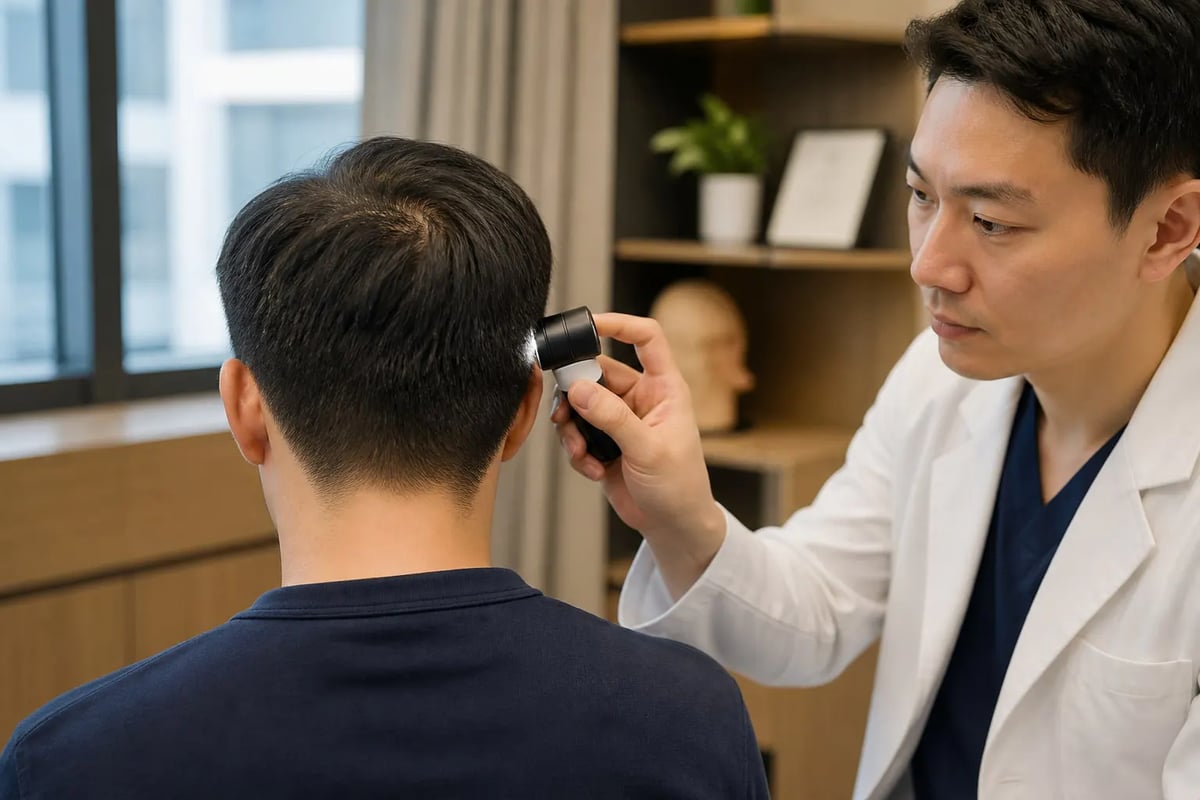
A follicular unit that is completely removed during FUE and transplanted elsewhere does not normally regrow at its original donor site. When the back of the scalp appears to “grow back”, the change is usually the surrounding unharvested hair becoming longer and covering the tiny extraction points—not the creation of a new follicle.
This does not mean that FUE must leave obvious thinning. The result depends on starting density, hair calibre, hair-to-skin contrast, extraction distribution, usual haircut and future hair-loss pattern. A safe graft number therefore cannot be chosen from a universal chart.
Key point: FUE redistributes a finite follicle supply; it does not increase the total number of scalp follicles. Donor planning must preserve natural-looking coverage and reserve options for future loss.
Does an FUE follicle regenerate in the donor area?
Follicular Unit Excision uses a small circular punch to separate and remove an intact follicular unit before it is implanted in the recipient area. The small wound heals, but the removed unit should not be expected to regenerate at the extraction site.
A hair transplant is therefore a redistribution procedure. Clinical practice guidelines describe careful donor examination and warn against overharvesting; they do not treat FUE as a source of newly generated follicles.
Why can the donor area look as though it has grown back?
The donor hair is commonly clipped before surgery. Over the following weeks and months, unharvested hairs grow longer and increase visual coverage. This is the main reason extraction points become less visible.
Some patients also develop temporary donor shock loss. Surgical stress can shift nearby existing hairs into a resting phase. If those follicles remain intact, recovery may occur over time, but a clinician should distinguish shock loss from follicular injury, infection or another scalp disorder.
| Donor-area finding | Is the follicle still there? | Likely course |
|---|---|---|
| Fully excised follicular unit | No | The same hair does not normally regrow at that point |
| Surrounding clipped hair | Yes | It lengthens and improves coverage |
| Temporary shock loss | Usually, but needs assessment | Some cases gradually recover over several months |
| Overharvesting or follicular injury | Reduced or damaged | Density loss may remain visible |
Can FUE leave a visibly thin patch?
No single graft count can guarantee that it will not. Well-spaced extractions in a sufficiently dense donor zone can be concealed by surrounding hair. The scalp becomes easier to see when density is low, hair is fine, hair and skin have strong colour contrast, the patient wears a very short cut, or one region is harvested repeatedly.

Assessment should compare follicular-unit density, calibre, multi-hair units and miniaturisation across the occipital and temporal zones. Published donor-area studies show meaningful variation between patients, so an average supply is not an individual prescription.
The required coverage must be balanced against supply. See how graft numbers are estimated and how many hair transplants may be possible for the wider planning context.
What is FUE overharvesting?
Overharvesting means that the quantity or concentration of extractions exceeds what that donor area can conceal naturally. It may look patchy or “moth-eaten”, create sharp borders, or make particular windows of scalp conspicuous after a short haircut.
Reviews of donor-area management and hair-transplant complications emphasise distribution, donor-zone definition and tissue handling—not a single maximum number. Early redness, crusting and uneven clipped hair do not prove overharvesting. Compare photographs at a similar hair length and lighting after healing; seek review sooner if thinning expands or pain, warmth, pustules or discharge develops.
Is FUE really scarless?
No. FUE avoids the single linear scar typical of FUT, but each extraction can leave a tiny round mark. “Different scar pattern” is more accurate than “scarless”. Punch size, healing, skin tone, extraction density and haircut all affect visibility.
Longer surrounding hair often conceals the marks. Very short hair, concentrated harvesting, pigment change or abnormal scarring can reveal them. Compare the methods in FUE, FUT and COMBO and read our focused guide to hair-transplant scars.
How long does the FUE donor area take to recover?
Recovery has three different endpoints: surface wound healing, regrowth of clipped hair and stabilisation of appearance. The tiny sites may crust and remain pink before healing, while temporary shedding can make the cosmetic recovery take months.
| Stage | Common appearance | What matters |
|---|---|---|
| First few days | Small extraction points, tightness, redness or crusts | Follow the clinic’s cleaning instructions; do not pick |
| Around 1–2 weeks | Surface healing and short-hair growth | Worsening pain, swelling or discharge needs review |
| Following months | Increasing hair length; possible recovery from shock loss | Compare at a similar length, angle and lighting |
| Long term | Appearance reflects remaining density, dot scars and future loss | Re-measure before any repeat procedure |
There is no responsible promise that every donor area will be invisible by a fixed date. Patients with an event, filming commitment or a very short hairstyle should make that requirement part of the preoperative plan.
How should the donor area be cared for?
Use the surgeon’s instructions for washing, medication and activity. General principles are gentle cleansing, leaving crusts alone and avoiding high-pressure water, fingernails or unapproved scalp products.

Avoid vigorous exercise and prolonged friction for the period advised. Increasing redness, heat, swelling, pain, pus, significant bleeding, fever or unusual skin colour warrants prompt contact with the surgical team. Our Common Hair Transplant Myths: Pain, Naturalness and Pre-Surgery Assessment covers washing, sleep and activity, but individual instructions take priority.
Can the same area be harvested again?
Some patients can undergo another FUE session, but a historical graft count is not enough. The surgeon must recheck remaining units, calibre, prior extraction distribution, scars, scalp health and progression of pattern hair loss.
If the donor area is already depleted, further extraction can make it less natural. Priorities may need to change, the graft target may need to fall, or another strategy may be discussed. Finite donor resources also make careful handling important; see our guide to growth and transplant failure risks.
Dr Wen-Yi Wu: plan the donor area for the future
An FUE assessment should not stop at “How many grafts can we take today?” It should ask whether the donor still looks natural at the patient’s usual hair length and whether enough supply remains if native hair continues to thin over the next five or ten years.
That requires measurements at multiple points, assessment of calibre and miniaturisation, distributed extraction and a clear discussion of hairstyle and long-term goals. If you are worried about postoperative thinning, bring preoperative photographs and the operation record. A review can distinguish short-hair regrowth, shock loss, scarring and true depletion before any further procedure is planned.
This article provides general medical education and cannot replace an individual diagnosis. Safe graft supply, recovery time and repeat surgery must be assessed by a doctor.
References
Do FUE grafts grow back in the donor area? +
Usually not. A follicular unit that has been fully removed and transplanted has left its original site. Apparent regrowth is generally neighbouring, unharvested hair growing longer and covering the extraction points.
Can FUE leave a bald patch in the donor area? +
It can leave visible thinning if the starting density is low, extraction is concentrated, hair is fine, the haircut is very short or the same area is harvested repeatedly. Individual measurement is essential.
Is FUE completely scarless? +
No. FUE typically leaves many tiny dot-like marks rather than the single linear scar associated with FUT. Their visibility depends on healing, skin tone, extraction density and hair length.
Does sudden donor-area shedding mean overharvesting? +
Not necessarily. Temporary donor shock loss, inflammation and other scalp conditions can look similar. Expanding loss, increasing pain, redness, pustules or discharge should be assessed promptly.
When can I cut the donor hair short after FUE? +
There is no universal date. The surface must heal first, and the remaining density and dot scars must be considered. Tell the surgeon before surgery if you normally wear a very short haircut.
Can the same donor area be harvested a second time? +
Sometimes, but remaining density, calibre, extraction pattern, scarring and miniaturisation must be measured again. A previously usable area is not automatically safe for the same extraction density later.
Related articles
This article has been reviewed and medically approved by Dr. Wen-Yi Wu

Dr. Wen-Yi Wu|Director, Mong Hair Clinic
- ● Fellow of ISHRS (FISHRS)
- ● ABHRS Board-Certified Hair Restoration Surgeon
- ● President of TSHRS (Taiwan Society of Hair Restoration Surgery)